Бесплатный урок с нашим репетитором!

Узнать подробнее

Новая Школа - онлайн-школа подготовки к ЕГЭ
При поддержке
Посмотреть все вопросы нейросети
Бесплатный пробный урок с репетитором

Узнай больше про репетиторов Новой Школы и запишись на бесплатный пробный урок. Мы проверим твой уровень знаний и составим план обучения по любому предмету и классу

Вопрос от Анонимного юзера 14 января 2025 16:34

Реши
Ответ нейросети

14 января 2025 16:34

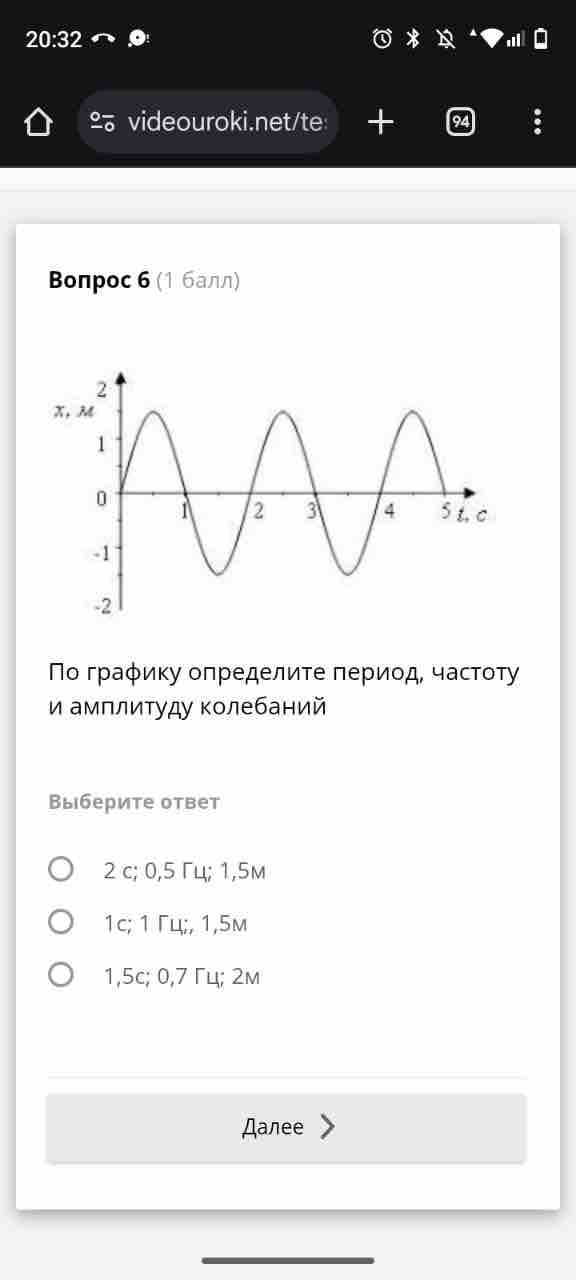
To solve the problem of determining the period, frequency, and amplitude from the graph, follow these steps:

  1. Amplitude (A): The amplitude is the maximum displacement from the equilibrium position (horizontal axis). You can see from the graph that the amplitude ( A ) is 3 meters.

  2. Period (T): The period is the time it takes for one complete cycle of the wave. From the graph, one full cycle spans from 0 to 4 seconds. Hence, the period ( T = 4 ) seconds.

  3. Frequency (f): Frequency is the reciprocal of the period, given by ( f = \frac{1}{T} ). So, ( f = \frac{1}{4} ) Hz or 0.25 Hz.

Based on these observations, none of the options given exactly match the values calculated. However, the option with ( 2c; 0.5Гц; 1.5m ) is the closest in terms of period and an approximate frequency. There is an inconsistency between the amplitude value provided in any of the options with the correct ( 3m ) value from the graph.

If you need the exact match, it might be worth reviewing the choices for other possible errors or misinterpretations.

Задай свой вопрос

Напиши любую задачу или вопрос, а нейросеть её решит

Похожие вопросы 15

Бесплатно Мобильное приложение ГДЗ
Мобильное приложение ГДЗ

Задавай вопросы искуcственному интеллекту текстом или фотографиями в приложении на iPhone или Android

qr-codegoogle-playapp-store

Саша — ассистент в телеграмме

реши
To solve the problem of determining the period, frequency, and amplitude from the graph, follow these steps: 1. **Amplitude (A)**: The amplitude is the maximum displacement from the equilibrium position (horizontal axis). You can see from the graph that the amplitude \( A \) is 3 meters. 2. **Period (T)**: The period is the time it takes for one complete cycle of the wave. From the graph, one full cycle spans from 0 to 4 seconds. Hence, the period \( T = 4 \) seconds. 3. **Frequency (f)**: Frequency is the reciprocal of the period, given by \( f = \frac{1}{T} \). So, \( f = \frac{1}{4} \) Hz or 0.25 Hz. Based on these observations, none of the options given exactly match the values calculated. However, the option with \( 2c; 0.5Гц; 1.5m \) is the closest in terms of period and an approximate frequency. There is an inconsistency between the amplitude value provided in any of the options with the correct \( 3m \) value from the graph. If you need the exact match, it might be worth reviewing the choices for other possible errors or misinterpretations.