Бесплатный урок с нашим репетитором!

Узнать подробнее

Новая Школа - онлайн-школа подготовки к ЕГЭ
При поддержке
Посмотреть все вопросы нейросети
Бесплатный пробный урок с репетитором

Узнай больше про репетиторов Новой Школы и запишись на бесплатный пробный урок. Мы проверим твой уровень знаний и составим план обучения по любому предмету и классу

Вопрос от Анонимного юзера 19 января 2025 19:11

.
Ответ нейросети

19 января 2025 19:11

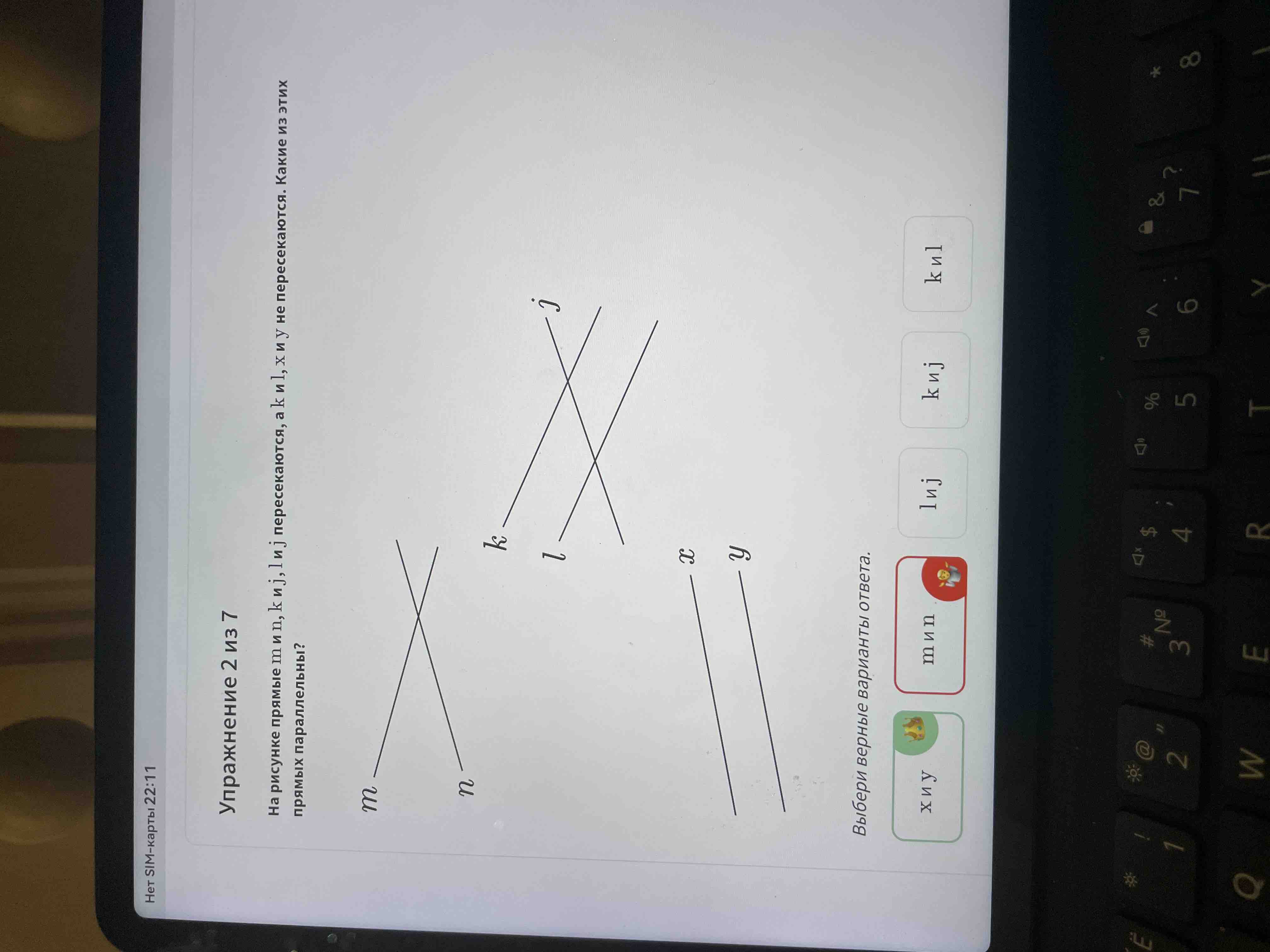
To solve the problem of determining which lines are parallel in the given diagram, observe the arrangement of each pair of lines:

  1. The lines labeled (m) and (n) do not intersect and appear parallel.
  2. The lines labeled (k) and (l) intersect, so they are not parallel.
  3. The lines labeled (x) and (y) do not intersect and appear parallel.
  4. The lines labeled (i) and (j) intersect, so they are not parallel.

Therefore, the correct pairs of parallel lines are:

  • (m \parallel n)
  • (x \parallel y)

From the options given below the diagram, the green button (x y) indicates the correct pairs of parallel lines.

Задай свой вопрос

Напиши любую задачу или вопрос, а нейросеть её решит

Похожие вопросы 15

Бесплатно Мобильное приложение ГДЗ
Мобильное приложение ГДЗ

Задавай вопросы искуcственному интеллекту текстом или фотографиями в приложении на iPhone или Android

qr-codegoogle-playapp-store

Саша — ассистент в телеграмме

.
To solve the problem of determining which lines are parallel in the given diagram, observe the arrangement of each pair of lines: 1. The lines labeled \(m\) and \(n\) do not intersect and appear parallel. 2. The lines labeled \(k\) and \(l\) intersect, so they are not parallel. 3. The lines labeled \(x\) and \(y\) do not intersect and appear parallel. 4. The lines labeled \(i\) and \(j\) intersect, so they are not parallel. Therefore, the correct pairs of parallel lines are: - \(m \parallel n\) - \(x \parallel y\) From the options given below the diagram, the green button (x y) indicates the correct pairs of parallel lines.