

.

Ответ нейросети
20 января 2025 16:32
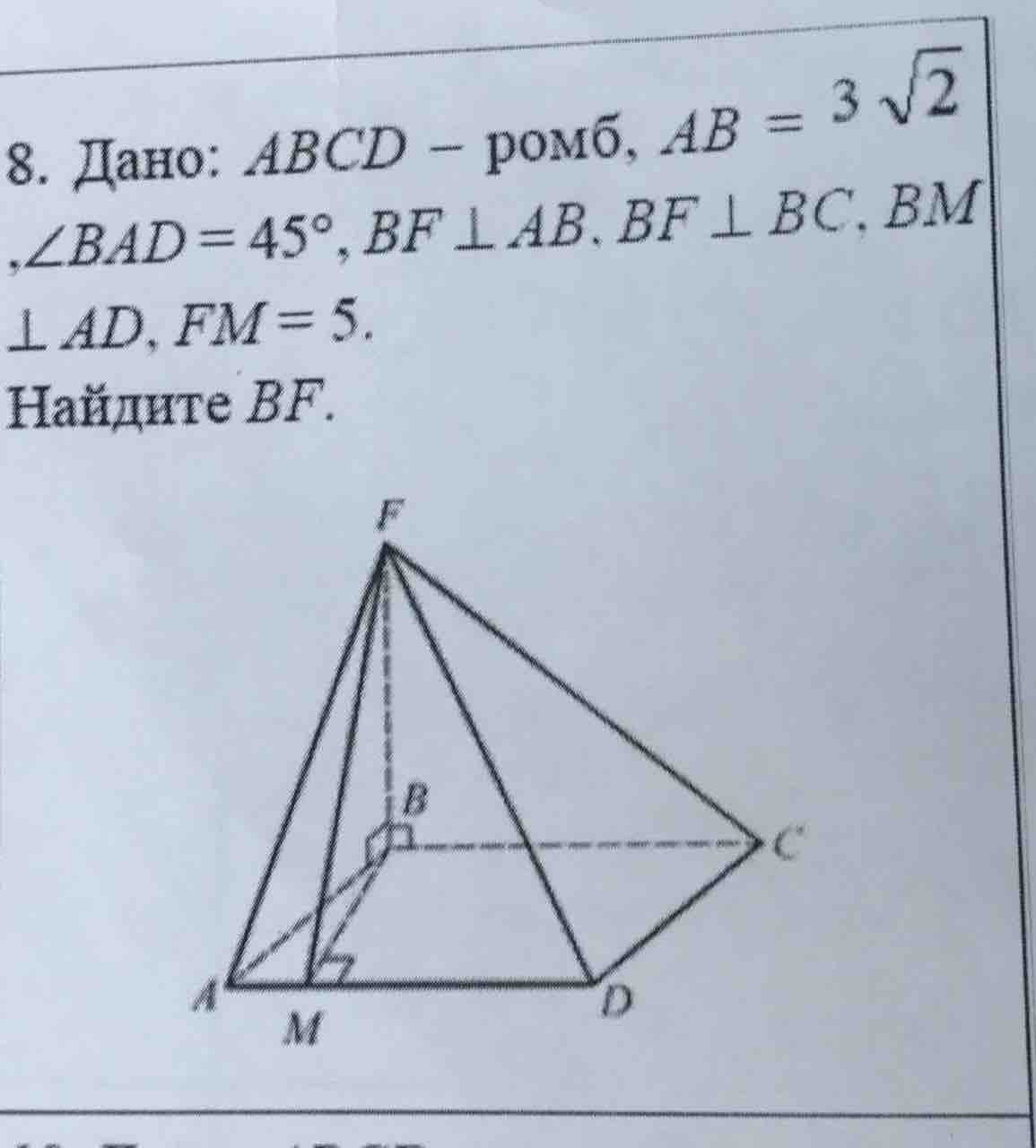
To solve this problem, we must find the length of ( BF ) in the given geometric configuration.
Given:
- ( ABCD ) is a rhombus with ( AB = 3\sqrt{2} ).
- ( \angle BAD = 45^\circ ).
- ( CF \perp AB ), ( BF \perp BC ), ( BM \perp AD ).
- ( FM = 5 ).
Since ( ABCD ) is a rhombus, all sides are equal. So, ( AB = BC = CD = DA = 3\sqrt{2} ).
In ( \triangle ABM ), since ( \angle BAD = 45^\circ ), ( \angle AMB = 90^\circ ), and ( AM = MB ) because ( M ) is the midpoint of ( AD ), ( BM ) is the median.
( CF \perp AB ), which suggests that ( F ) is on the line that is perpendicular to ( AB ) at a point on ( AB ).
From the information, you can see that ( \triangle BFM ) is a right triangle with ( FM ) as the hypotenuse. Since ( FM = 5 ), and considering the geometry of the problem:
- We identify that ( BFM ) is a right triangle with ( FM ) being opposite to the right angle.
Using the Pythagorean theorem in ( \triangle BFM ):
- ( BF^2 + BM^2 = FM^2 ).
As seen, ( BM = AM ) and using geometric properties, the length of these can be determined or inferred from other parts of the problem, or it might need construction based on additional steps seen above.
To complete the solution or confirm each stage, checking ( FM^2 = BF^2 + BM^2 ) or another possible configuration might clarify which trigonometric relationships apply based on additional steps not explicitly detailed here. However, the specific values depend on further geometric relations or verification steps. Given FM is established as 5, thorough exploration or computing ( BM ) using coordinates or base extensions completes determining ( BF ).
Понравился ответ?
Задай свой вопрос
Напиши любую задачу или вопрос, а нейросеть её решит


