Бесплатный урок с нашим репетитором!

Узнать подробнее

Новая Школа - онлайн-школа подготовки к ЕГЭ
При поддержке
Посмотреть все вопросы нейросети
Бесплатный пробный урок с репетитором

Узнай больше про репетиторов Новой Школы и запишись на бесплатный пробный урок. Мы проверим твой уровень знаний и составим план обучения по любому предмету и классу

Вопрос от Анонимного юзера 23 января 2025 08:31

4

Ответ нейросети

23 января 2025 08:31

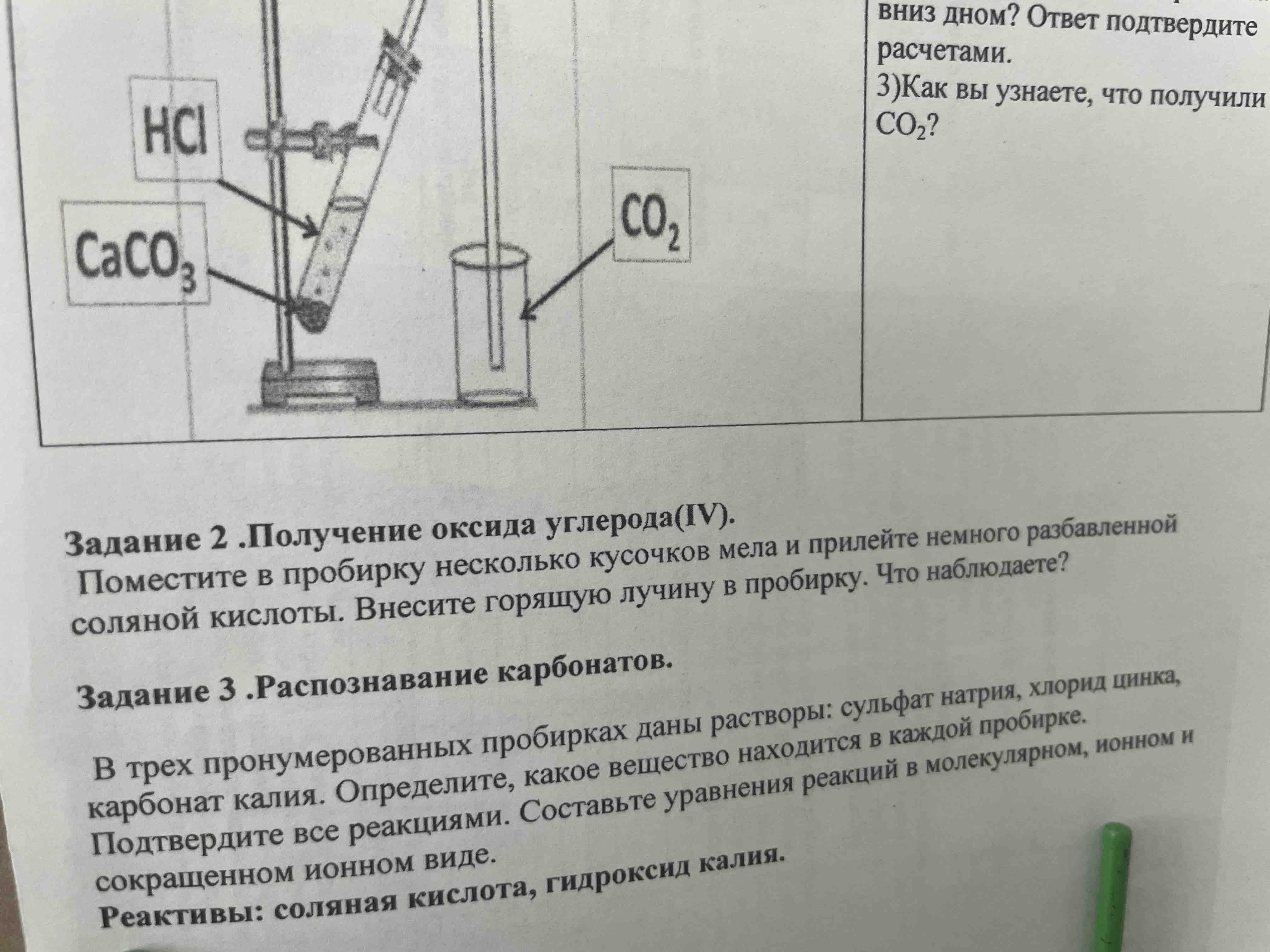
The tasks in the image are chemistry-related exercises. Here's a summary of what each task involves:

Задание 2. Получение оксида углерода(IV).

  1. Получение CO₂: You need to place a few pieces of chalk (calcium carbonate, CaCO₃) into a test tube and add some hydrochloric acid (HCl). This reaction will produce carbon dioxide (CO₂), water, and calcium chloride (CaCl₂).

    • Chemical Reaction: [ \text{CaCO}_3 + 2 \text{HCl} \rightarrow \text{CaCl}_2 + \text{CO}_2 + \text{H}_2\text{O} ]
  2. Testing for CO₂: Introduce a burning splint into the test tube. If the flame extinguishes, it indicates the presence of CO₂, which is heavier than air and does not support combustion.

Задание 3. Распознавание карбонатов.

This task involves identifying sodium (Na), calcium chloride (CaCl₂), and potassium carbonate (K₂CO₃) using three different labeled test tubes.

  1. Reactants Provided: You are given hydrochloric acid and sodium hydroxide (NaOH).

  2. Objective: Determine which reaction, when added to a carbonate, will produce CO₂ gas.

  3. Chemical Reactions:

    • For a carbonate with an acid: [ \text{Na}_2\text{CO}_3 + 2\text{HCl} \rightarrow 2\text{NaCl} + \text{CO}_2 + \text{H}_2\text{O} ]
    • For a carbonate with a base (like NaOH), there will be no reaction.

By following these guidelines, you can perform these experiments and identify the substances based on the reactions observed.

Задай свой вопрос

Напиши любую задачу или вопрос, а нейросеть её решит

Похожие вопросы 15

Бесплатно Мобильное приложение ГДЗ
Мобильное приложение ГДЗ

Задавай вопросы искуcственному интеллекту текстом или фотографиями в приложении на iPhone или Android

qr-codegoogle-playapp-store

Саша — ассистент в телеграмме

4
The tasks in the image are chemistry-related exercises. Here's a summary of what each task involves: **Задание 2. Получение оксида углерода(IV).** 1. **Получение CO₂:** You need to place a few pieces of chalk (calcium carbonate, CaCO₃) into a test tube and add some hydrochloric acid (HCl). This reaction will produce carbon dioxide (CO₂), water, and calcium chloride (CaCl₂). - **Chemical Reaction:** \[ \text{CaCO}_3 + 2 \text{HCl} \rightarrow \text{CaCl}_2 + \text{CO}_2 + \text{H}_2\text{O} \] 2. **Testing for CO₂:** Introduce a burning splint into the test tube. If the flame extinguishes, it indicates the presence of CO₂, which is heavier than air and does not support combustion. **Задание 3. Распознавание карбонатов.** This task involves identifying sodium (Na), calcium chloride (CaCl₂), and potassium carbonate (K₂CO₃) using three different labeled test tubes. 1. **Reactants Provided:** You are given hydrochloric acid and sodium hydroxide (NaOH). 2. **Objective:** Determine which reaction, when added to a carbonate, will produce CO₂ gas. 3. **Chemical Reactions:** - For a carbonate with an acid: \[ \text{Na}_2\text{CO}_3 + 2\text{HCl} \rightarrow 2\text{NaCl} + \text{CO}_2 + \text{H}_2\text{O} \] - For a carbonate with a base (like NaOH), there will be no reaction. By following these guidelines, you can perform these experiments and identify the substances based on the reactions observed.