Бесплатный урок с нашим репетитором!

Узнать подробнее

Новая Школа - онлайн-школа подготовки к ЕГЭ
При поддержке
Посмотреть все вопросы нейросети
Бесплатный пробный урок с репетитором

Узнай больше про репетиторов Новой Школы и запишись на бесплатный пробный урок. Мы проверим твой уровень знаний и составим план обучения по любому предмету и классу

Вопрос от Полнейший Абьюзер 14 февраля 2025 06:25

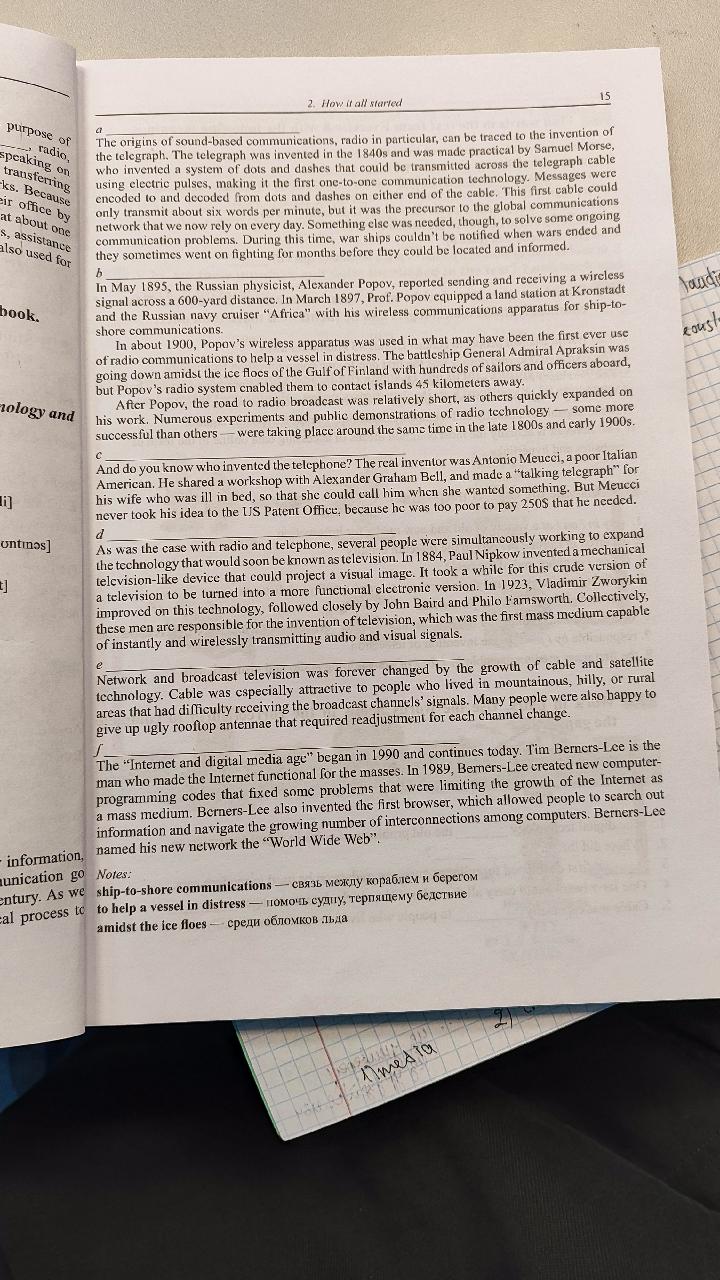
Реши номер 8 We live in a media-saturated world and rely on a variety of old and new media for information entertainment, and connection. The beginnings of mass media and mass communication #Votes back 560 years to the "print revolution" that occurred in Europe in the fifteenth century. As progressed through the centuries, mass communication evolved from a mechanical process electronic transmission, which paved the way for the digitized world of today a The origins of sound-based communications, radio in particular, can be traced to the invention of the telegraph. The telegraph was invented in the 1840s and was made practical by Samuel Morse, who invented a system of dots and dashes that could be transmitted across the telegraph cable using electric pulses, making it the first one-to-one communication technology. Messages were encoded to and decoded from dots and dashes on either end of the cable. This first cable could only transmit about six words per minute, but it was the precursor to the global communications network that we now rely on every day. Something else was needed, though, to solve some ongoing communication problems. During this time, war ships couldn't be notified when wars ended and they sometimes went on fighting for months before they could be located and informed. book. h In May 1895, the Russian physicist, Alexander Popov, reported sending and receiving a wireless signal across a 600-yard distance. In March 1897, Prof. Popov equipped a land station at Kronstadt and the Russian navy cruiser "Africa" with his wireless communications apparatus for ship-to-shore communications.. In about 1900, Popov's wireless apparatus was used in what may have been the first ever use of radio communications to help a vessel in distress. The battleship General Admiral Apraksin was going down amidst the ice floes of the Gulf of Finland with hundreds of sailors and officers aboard, but Popov's radio system enabled them to contact islands 45 kilometers away. nology and After Popov, the road to radio broadcast was relatively short, as others quickly expanded on his work. Numerous experiments and public demonstrations of radio technology some more successful than others were taking place around the same time in the late 1800s and early 1900s. And do you know who invented the telephone? The real inventor was Antonio Meucci, a poor Italian American. He shared a workshop with Alexander Graham Bell, and made a "talking telegraph" for his wife who was ill in bed, so that she could call him when she wanted something. But Meucci never took his idea to the US Patent Office, because he was too poor to pay 2505 that he needed. untinǝs] d As was the case with radio and telephone, several people were simultaneously working to expand the technology that would soon be known as television. In 1884, Paul Nipkow invented a mechanical television-like device that could project a visual image. It took a while for this crude version of a television to be turned into a more functional electronic version. In 1923, Vladimir Zworykin improved on this technology, followed closely by John Baird and Philo Farnsworth. Collectively, these men are responsible for the invention of television, which was the first mass medium capable of instantly and wirelessly transmitting audio and visual signals. e Network and broadcast television was forever changed by the growth of cable and satellite technology. Cable was especially attractive to people who lived in mountainous, hilly, or rural areas that had difficulty receiving the broadcast channels' signals. Many people were also happy to give up ugly rooftop antennae that required readjustment for each channel change. The "Internet and digital media age" began in 1990 and continues today. Tim Berners-Lee is the man who made the Internet functional for the masses. In 1989, Berners-Lee created new computer-programming codes that fixed some problems that were limiting the growth of the Internet as a mass medium. Berners-Lee also invented the first browser, which allowed people to search out information and navigate the growing number of interconnections among computers. Berners-Lee named his new network the "World Wide Web".
Ответ нейросети

14 февраля 2025 06:25

Похоже, вы дали отрывок текста, касающийся истории средств массовой информации и технологий коммуникации. Давайте обобщим и объясним ключевые моменты, поскольку вы хотите понять эту тему.

Обзор истории коммуникационных технологий

  1. Печатная революция:

    • Начало массовых коммуникаций связывают с печатной революцией в Европе в XV веке. Это было первое масштабное использование технологии для распространения информации.
  2. Изобретение телеграфа:

    • Телеграф был изобретен в 1840-х годах и стал первой технологией передачи сообщений посредством электрических сигналов. Это было важно для коммуникаций на больших расстояниях, хотя и медленно – около шести слов в минуту.
  3. Радио:

    • В 1895 году Александр Попов осуществил передачу беспроводного сигнала, и в 1897 году использовал свое оборудование для связи с военными кораблями. Это был большой шаг вперед в развитии радиосвязи, особенно для помощи кораблям и коммуникации в сложных условиях.
  4. Телефон:

    • Антонио Меуччи изобрел "говорящий телеграф" еще до Александра Белла, но не мог позволить себе запатентовать свое изобретение. Телефон стал следующим этапом в развитии личной коммуникации.
  5. Телевидение:

    • В 1884 году Пауль Нипков создает механическое устройство для передачи изображений. Последующие усовершенствования, внесенные людьми, такими как Владимир Зворыкин, сделали телевидение массовым средством передачи аудио и видео.
  6. Кабельное и спутниковое телевидение:

    • Развитие кабельного и спутникового ТВ расширило доступ к коммуникациям для людей в удаленных и труднодоступных местах.
  7. Интернет и цифровые медиа:

    • В 1990 году Тим Бернерс-Ли разработал важные коды для развития Интернета, сделав его доступным для широкой публики и создав первый веб-браузер, что стало основой для Всемирной паутины.

Заключение

Эти нововведения сыграли ключевую роль в развитии современных средств массовой информации и коммуникаций, от начальных механических технологий до сложных цифровых систем, которыми мы пользуемся сегодня. Надеюсь, это помогло вам лучше понять материал! Если у вас есть конкретные вопросы или нуждаетесь в объяснении какого-либо аспекта более подробно, пожалуйста, дайте знать.

Задай свой вопрос

Напиши любую задачу или вопрос, а нейросеть её решит

Похожие вопросы 15

Бесплатно Мобильное приложение ГДЗ
Мобильное приложение ГДЗ

Задавай вопросы искуcственному интеллекту текстом или фотографиями в приложении на iPhone или Android

qr-codegoogle-playapp-store

Саша — ассистент в телеграмме

реши номер 8 We live in a media-saturated world and rely on a variety of old and new media for information entertainment, and connection. The beginnings of mass media and mass communication #Votes back 560 years to the "print revolution" that occurred in Europe in the fifteenth century. As progressed through the centuries, mass communication evolved from a mechanical process electronic transmission, which paved the way for the digitized world of today a The origins of sound-based communications, radio in particular, can be traced to the invention of the telegraph. The telegraph was invented in the 1840s and was made practical by Samuel Morse, who invented a system of dots and dashes that could be transmitted across the telegraph cable using electric pulses, making it the first one-to-one communication technology. Messages were encoded to and decoded from dots and dashes on either end of the cable. This first cable could only transmit about six words per minute, but it was the precursor to the global communications network that we now rely on every day. Something else was needed, though, to solve some ongoing communication problems. During this time, war ships couldn't be notified when wars ended and they sometimes went on fighting for months before they could be located and informed. book. h In May 1895, the Russian physicist, Alexander Popov, reported sending and receiving a wireless signal across a 600-yard distance. In March 1897, Prof. Popov equipped a land station at Kronstadt and the Russian navy cruiser "Africa" with his wireless communications apparatus for ship-to-shore communications.. In about 1900, Popov's wireless apparatus was used in what may have been the first ever use of radio communications to help a vessel in distress. The battleship General Admiral Apraksin was going down amidst the ice floes of the Gulf of Finland with hundreds of sailors and officers aboard, but Popov's radio system enabled them to contact islands 45 kilometers away. nology and After Popov, the road to radio broadcast was relatively short, as others quickly expanded on his work. Numerous experiments and public demonstrations of radio technology some more successful than others were taking place around the same time in the late 1800s and early 1900s. And do you know who invented the telephone? The real inventor was Antonio Meucci, a poor Italian American. He shared a workshop with Alexander Graham Bell, and made a "talking telegraph" for his wife who was ill in bed, so that she could call him when she wanted something. But Meucci never took his idea to the US Patent Office, because he was too poor to pay 2505 that he needed. untinǝs] d As was the case with radio and telephone, several people were simultaneously working to expand the technology that would soon be known as television. In 1884, Paul Nipkow invented a mechanical television-like device that could project a visual image. It took a while for this crude version of a television to be turned into a more functional electronic version. In 1923, Vladimir Zworykin improved on this technology, followed closely by John Baird and Philo Farnsworth. Collectively, these men are responsible for the invention of television, which was the first mass medium capable of instantly and wirelessly transmitting audio and visual signals. e Network and broadcast television was forever changed by the growth of cable and satellite technology. Cable was especially attractive to people who lived in mountainous, hilly, or rural areas that had difficulty receiving the broadcast channels' signals. Many people were also happy to give up ugly rooftop antennae that required readjustment for each channel change. The "Internet and digital media age" began in 1990 and continues today. Tim Berners-Lee is the man who made the Internet functional for the masses. In 1989, Berners-Lee created new computer-programming codes that fixed some problems that were limiting the growth of the Internet as a mass medium. Berners-Lee also invented the first browser, which allowed people to search out information and navigate the growing number of interconnections among computers. Berners-Lee named his new network the "World Wide Web".
Похоже, вы дали отрывок текста, касающийся истории средств массовой информации и технологий коммуникации. Давайте обобщим и объясним ключевые моменты, поскольку вы хотите понять эту тему. ### Обзор истории коммуникационных технологий 1. **Печатная революция:** - Начало массовых коммуникаций связывают с печатной революцией в Европе в XV веке. Это было первое масштабное использование технологии для распространения информации. 2. **Изобретение телеграфа:** - Телеграф был изобретен в 1840-х годах и стал первой технологией передачи сообщений посредством электрических сигналов. Это было важно для коммуникаций на больших расстояниях, хотя и медленно – около шести слов в минуту. 3. **Радио:** - В 1895 году Александр Попов осуществил передачу беспроводного сигнала, и в 1897 году использовал свое оборудование для связи с военными кораблями. Это был большой шаг вперед в развитии радиосвязи, особенно для помощи кораблям и коммуникации в сложных условиях. 4. **Телефон:** - Антонио Меуччи изобрел "говорящий телеграф" еще до Александра Белла, но не мог позволить себе запатентовать свое изобретение. Телефон стал следующим этапом в развитии личной коммуникации. 5. **Телевидение:** - В 1884 году Пауль Нипков создает механическое устройство для передачи изображений. Последующие усовершенствования, внесенные людьми, такими как Владимир Зворыкин, сделали телевидение массовым средством передачи аудио и видео. 6. **Кабельное и спутниковое телевидение:** - Развитие кабельного и спутникового ТВ расширило доступ к коммуникациям для людей в удаленных и труднодоступных местах. 7. **Интернет и цифровые медиа:** - В 1990 году Тим Бернерс-Ли разработал важные коды для развития Интернета, сделав его доступным для широкой публики и создав первый веб-браузер, что стало основой для Всемирной паутины. ### Заключение Эти нововведения сыграли ключевую роль в развитии современных средств массовой информации и коммуникаций, от начальных механических технологий до сложных цифровых систем, которыми мы пользуемся сегодня. Надеюсь, это помогло вам лучше понять материал! Если у вас есть конкретные вопросы или нуждаетесь в объяснении какого-либо аспекта более подробно, пожалуйста, дайте знать.