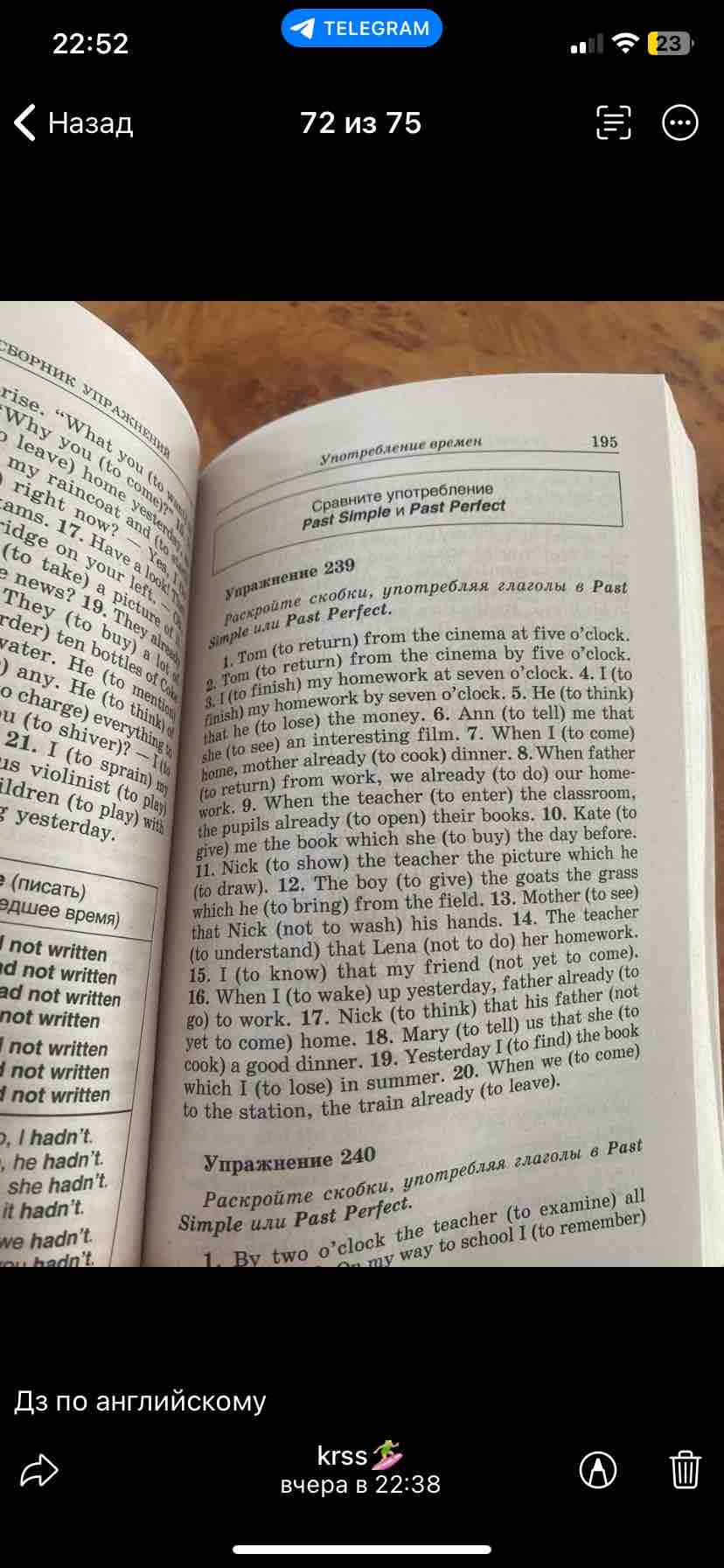
Упражнение 239
раскройте скобки, употребляя глаголы в Past
Simple unu Past Perfect.
1. Tom (to return) from the cinema at five o'clock.
2. Tom (to return) from the cinema by five o'clock.
3. I (to finish) my homework at seven o'clock. 4. I (to finish) my homework by seven o'clock. 5. He (to think) that he (to lose) the money. 6. Ann (to tell) me that she (to see) an interesting film. 7. When I (to come) home, mother already (to cook) dinner. 8. When father (to return) from work, we already (to do) our home-work.
9. When the teacher (to enter) the classroom, the pupils already (to open) their books. 10. Kate (to give) me the book which she (to buy) the day before.
11. Nick (to show) the teacher the picture which he (to draw). 12. The boy (to give) the goats the grass which he (to bring) from the field. 13. Mother (to see) that Nick (not to wash) his hands. 14. The teacher (to understand) that Lena (not to do) her homework.
15. I (to know) that my friend (not yet to come).
16. When I (to wake) up yesterday, father already (to
80) to work. 17. Nick (to think) that his father (not yet to come) home. 18. Mary (to tell) us that she (to cook) a good dinner. 19. Yesterday I (to find) the book which I (to lose) in summer. 20. When we (to come) to the station, the train already (to leave).
Чтобы решить это упражнение, нужно правильно употребить глаголы в формах Past Simple и Past Perfect, исходя из контекста предложений. Вот объяснение и решения:
1. **Tom returned from the cinema at five o'clock.**
- Используем **Past Simple**, так как просто указано время действия в прошлом.
2. **Tom had returned from the cinema by five o'clock.**
- Используем **Past Perfect**, чтобы показать, что действие было завершено к определенному моменту в прошлом.
3. **I finished my homework at seven o'clock.**
- Используем **Past Simple**, потому что речь идет о времени, когда действие произошло.
4. **I had finished my homework by seven o'clock.**
- **Past Perfect**, чтобы подчеркнуть завершенность к определенному времени.
5. **He thought that he had lost the money.**
- Основное действие в **Past Simple** (думал), а предшествующее (потерял) в **Past Perfect**.
6. **Ann told me that she had seen an interesting film.**
- Основное действие в **Past Simple** (сказала), а предшествующее (видела) в **Past Perfect**.
7. **When I came home, mother had already cooked dinner.**
- Для подчеркнутия, что ужин был готов до прихода: пришел (Past Simple), приготовила (Past Perfect).
8. **When father returned from work, we had already done our homework.**
- Мы сделали домашнюю работу до его возвращения.
9. **When the teacher entered the classroom, the pupils had already opened their books.**
- К моменту прихода учителя книги уже были открыты.
10. **Kate gave me the book which she had bought the day before.**
- Она купила книгу до того, как отдала ее мне.
11. **Nick showed the teacher the picture which he had drawn.**
- Рисунок был нарисован до показа учителю.
12. **The boy gave the goats the grass which he had brought from the field.**
- Трава была принесена до того, как ее получили козы.
13. **Mother saw that Nick had not washed his hands.**
- Мытье рук должно было произойти до момента, когда мать увидела.
14. **The teacher understood that Lena had not done her homework.**
- Отсутствие домашней работы предшествовало моменту, когда учитель это понял.
15. **I knew that my friend had not yet come.**
- Узнал, что он еще не пришел.
16. **When I woke up yesterday, father had already gone to work.**
- Он ушел на работу до того, как я проснулся.
17. **Nick thought that his father had not yet come home.**
- Дома еще не было на момент его раздумий.
18. **Mary told us that she had cooked a good dinner.**
- Ужин был приготовлен до момента ее слов.
19. **Yesterday I found the book which I had lost in summer.**
- Потеря книги произошла до ее нахождения.
20. **When we came to the station, the train had already left.**
- Поезд ушел до нашего прибытия на станцию.
Таким образом, Past Perfect используется для действий, завершившихся к определенному моменту в прошлом, а Past Simple для событий, происходивших в конкретный момент в прошлом.