

Вопрос от Анонимного юзера 10 января 2025 12:04
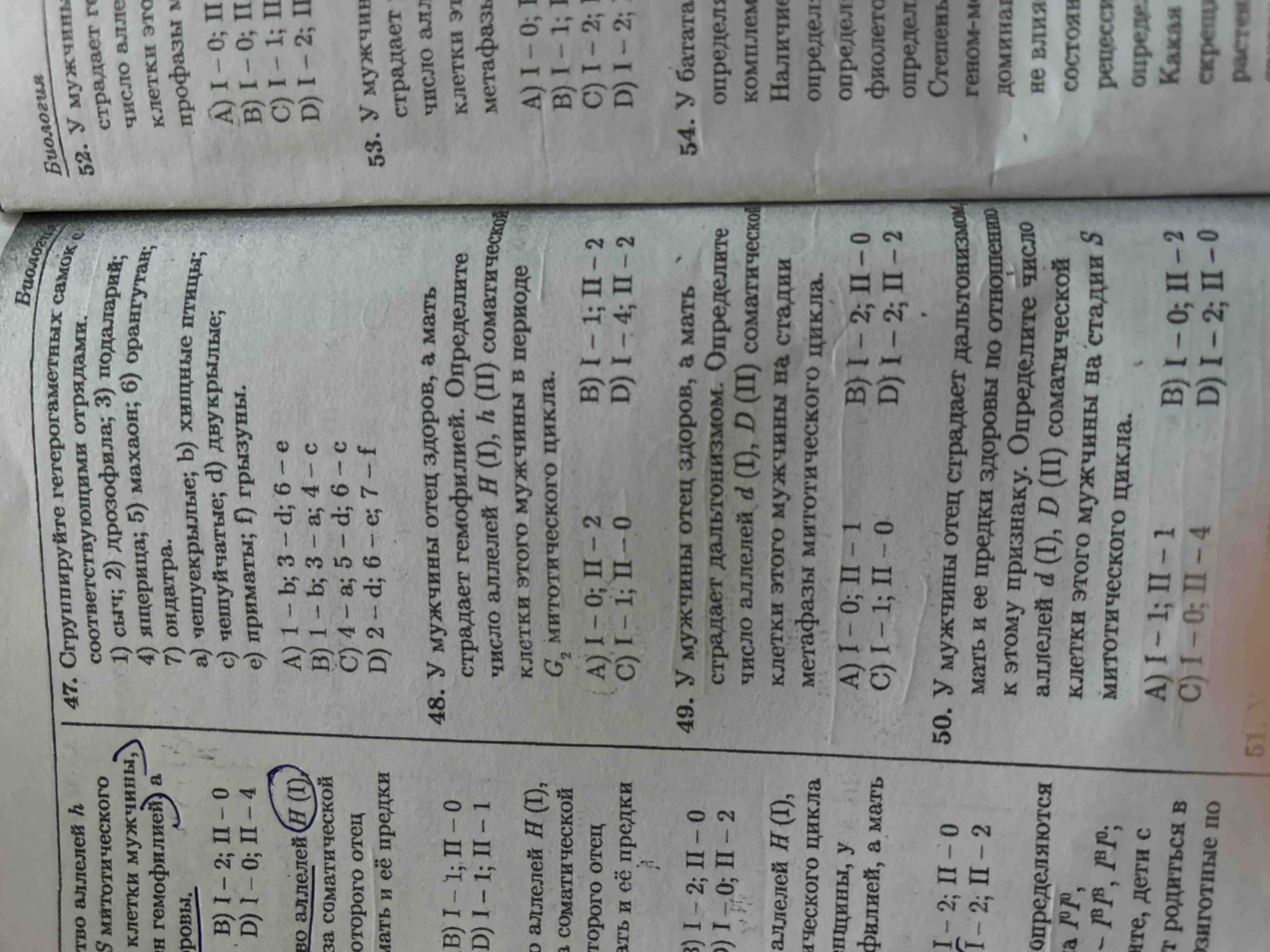
48

Ответ нейросети
10 января 2025 12:04
To solve question 48 in the image, we need to determine the number of different (i) alleles and (ii) chromosome sets (n) in somatic cells and during mitotic and meiotic cycles.
Given:
- The man’s father is healthy.
- The mother has hemophilia (a recessive X-linked condition).
X-Linked Hemophilia Summary:
- Males (XY) inherit the X chromosome from their mother and the Y chromosome from their father.
- Hemophilia is X-linked recessive.
Analyzing the Son’s Genotype:
- The mother has hemophilia, so she has the genotype X(^h)X(^h).
- The father is healthy, which means the Y from the father does not carry the hemophilia gene.
Thus, the son's genotype would be:
X(^h)Y (hemophiliac male).
Now, let’s answer the specific question regarding mitotic and meiotic cycles:
Somatic Cells:
- Number of Alleles (i): The son would have two alleles in each gene locus in somatic cells considering both chromosomes specify different alleles.
- Chromosome Sets (n): Diploid (2n) for somatic cells.
Mitotic Cycle:
- Number of Alleles (i): Each chromatid will replicate, maintaining the allele count.
- Chromosome Sets (n): Remains 2n since it replicates and splits identically.
Meiotic Cycle:
- Number of Alleles (i): The process includes crossing over, but genetic count remains by alleles getting assorted.
- Chromosome Sets (n): Reduced to n (haploid) because meiosis results in half the number of chromosomes.
Choices Listed:
Use these concepts to match the son’s condition to the given answer options.
Понравился ответ?
Задай свой вопрос
Напиши любую задачу или вопрос, а нейросеть её решит


