Бесплатный урок с нашим репетитором!

Узнать подробнее

Новая Школа - онлайн-школа подготовки к ЕГЭ
При поддержке
Посмотреть все вопросы нейросети
Бесплатный пробный урок с репетитором

Узнай больше про репетиторов Новой Школы и запишись на бесплатный пробный урок. Мы проверим твой уровень знаний и составим план обучения по любому предмету и классу

Вопрос от Анонимного юзера 15 января 2025 21:05

.

Ответ нейросети

15 января 2025 21:05

Let's solve each system of equations step by step:

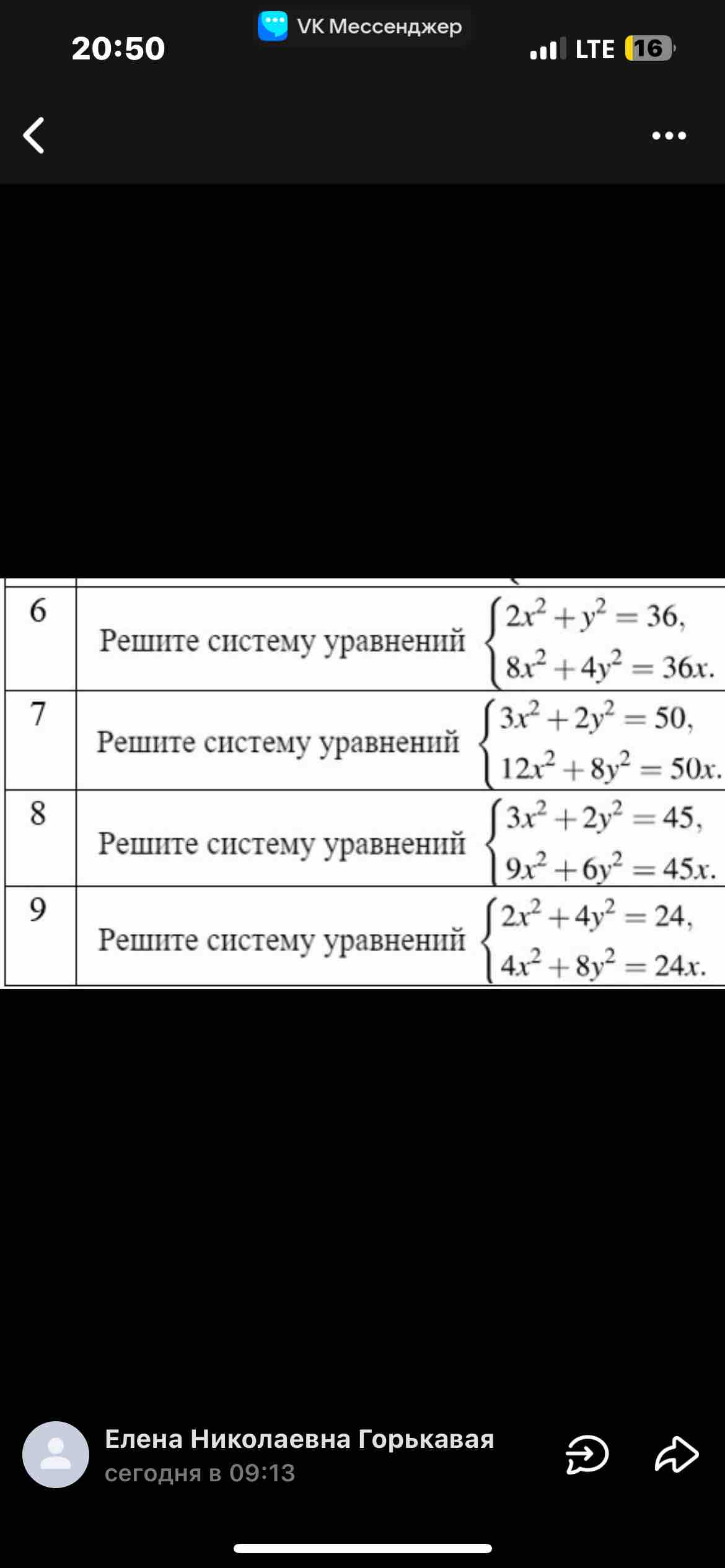
Problem 6: [ \begin{cases} 3x^2 + y^2 = 36 \ 8x^2 + 4y^2 = 56 \end{cases} ]

  1. Divide the second equation by 4: [ 2x^2 + y^2 = 14 ]

  2. Subtract the second equation from the first: [ (3x^2 + y^2) - (2x^2 + y^2) = 36 - 14 \ x^2 = 22 ]

  3. Substitute ( x^2 = 22 ) into ( 2x^2 + y^2 = 14 ): [ 2(22) + y^2 = 14 \ 44 + y^2 = 14 \ y^2 = -30 ]

    No real solutions since ( y^2 ) cannot be negative.

Problem 7: [ \begin{cases} 3x^2 + y^2 = 45 \ 12x^2 + 8y^2 = 50 \end{cases} ]

  1. Divide the second equation by 4: [ 3x^2 + 2y^2 = 12.5 ]

  2. Subtract the second equation from the first: [ (3x^2 + y^2) - (3x^2 + 2y^2) = 45 - 12.5 \ -y^2 = 32.5 ]

    No real solutions since ( y^2 ) cannot be negative.

Problem 8: [ \begin{cases} x^2 + y^2 = 9 \ 4x^2 + 9y^2 = 45 \end{cases} ]

  1. Multiply the first equation by 4: [ 4x^2 + 4y^2 = 36 ]

  2. Subtract the first from the second: [ (4x^2 + 9y^2) - (4x^2 + 4y^2) = 45 - 36 \ 5y^2 = 9 \ y^2 = \frac{9}{5}, \quad y = \pm\sqrt{\frac{9}{5}} ]

  3. Substitute ( y^2 = \frac{9}{5} ) into ( x^2 + y^2 = 9 ): [ x^2 + \frac{9}{5} = 9 \ x^2 = 9 - \frac{9}{5} \ x^2 = \frac{36}{5}, \quad x = \pm\sqrt{\frac{36}{5}} ]

    Real solutions are: [ x = \pm\sqrt{\frac{36}{5}}, \quad y = \pm\sqrt{\frac{9}{5}} ]

Problem 9: [ \begin{cases} x^2 + 3y^2 = 16 \ 4x^2 + 2y^2 = 24 \end{cases} ]

  1. Divide the second equation by 2: [ 2x^2 + y^2 = 12 ]

  2. Multiply the first equation by 2: [ 2x^2 + 6y^2 = 32 ]

  3. Subtract the second equation from the first: [ (2x^2 + 6y^2) - (2x^2 + y^2) = 32 - 12 \ 5y^2 = 20 \ y^2 = 4, \quad y = \pm 2 ]

  4. Substitute ( y^2 = 4 ) into ( x^2 + 3y^2 = 16 ): [ x^2 + 3(4) = 16 \ x^2 = 16 - 12 \ x^2 = 4, \quad x = \pm 2 ]

    Real solutions are: [ x = \pm 2, \quad y = \pm 2 ]

Задай свой вопрос

Напиши любую задачу или вопрос, а нейросеть её решит

Похожие вопросы 15

Бесплатно Мобильное приложение ГДЗ
Мобильное приложение ГДЗ

Задавай вопросы искуcственному интеллекту текстом или фотографиями в приложении на iPhone или Android

qr-codegoogle-playapp-store

Саша — ассистент в телеграмме

.
Let's solve each system of equations step by step: **Problem 6:** \[ \begin{cases} 3x^2 + y^2 = 36 \\ 8x^2 + 4y^2 = 56 \end{cases} \] 1. Divide the second equation by 4: \[ 2x^2 + y^2 = 14 \] 2. Subtract the second equation from the first: \[ (3x^2 + y^2) - (2x^2 + y^2) = 36 - 14 \\ x^2 = 22 \] 3. Substitute \( x^2 = 22 \) into \( 2x^2 + y^2 = 14 \): \[ 2(22) + y^2 = 14 \\ 44 + y^2 = 14 \\ y^2 = -30 \] No real solutions since \( y^2 \) cannot be negative. **Problem 7:** \[ \begin{cases} 3x^2 + y^2 = 45 \\ 12x^2 + 8y^2 = 50 \end{cases} \] 1. Divide the second equation by 4: \[ 3x^2 + 2y^2 = 12.5 \] 2. Subtract the second equation from the first: \[ (3x^2 + y^2) - (3x^2 + 2y^2) = 45 - 12.5 \\ -y^2 = 32.5 \] No real solutions since \( y^2 \) cannot be negative. **Problem 8:** \[ \begin{cases} x^2 + y^2 = 9 \\ 4x^2 + 9y^2 = 45 \end{cases} \] 1. Multiply the first equation by 4: \[ 4x^2 + 4y^2 = 36 \] 2. Subtract the first from the second: \[ (4x^2 + 9y^2) - (4x^2 + 4y^2) = 45 - 36 \\ 5y^2 = 9 \\ y^2 = \frac{9}{5}, \quad y = \pm\sqrt{\frac{9}{5}} \] 3. Substitute \( y^2 = \frac{9}{5} \) into \( x^2 + y^2 = 9 \): \[ x^2 + \frac{9}{5} = 9 \\ x^2 = 9 - \frac{9}{5} \\ x^2 = \frac{36}{5}, \quad x = \pm\sqrt{\frac{36}{5}} \] Real solutions are: \[ x = \pm\sqrt{\frac{36}{5}}, \quad y = \pm\sqrt{\frac{9}{5}} \] **Problem 9:** \[ \begin{cases} x^2 + 3y^2 = 16 \\ 4x^2 + 2y^2 = 24 \end{cases} \] 1. Divide the second equation by 2: \[ 2x^2 + y^2 = 12 \] 2. Multiply the first equation by 2: \[ 2x^2 + 6y^2 = 32 \] 3. Subtract the second equation from the first: \[ (2x^2 + 6y^2) - (2x^2 + y^2) = 32 - 12 \\ 5y^2 = 20 \\ y^2 = 4, \quad y = \pm 2 \] 4. Substitute \( y^2 = 4 \) into \( x^2 + 3y^2 = 16 \): \[ x^2 + 3(4) = 16 \\ x^2 = 16 - 12 \\ x^2 = 4, \quad x = \pm 2 \] Real solutions are: \[ x = \pm 2, \quad y = \pm 2 \]