

.

Ответ нейросети
22 января 2025 09:43
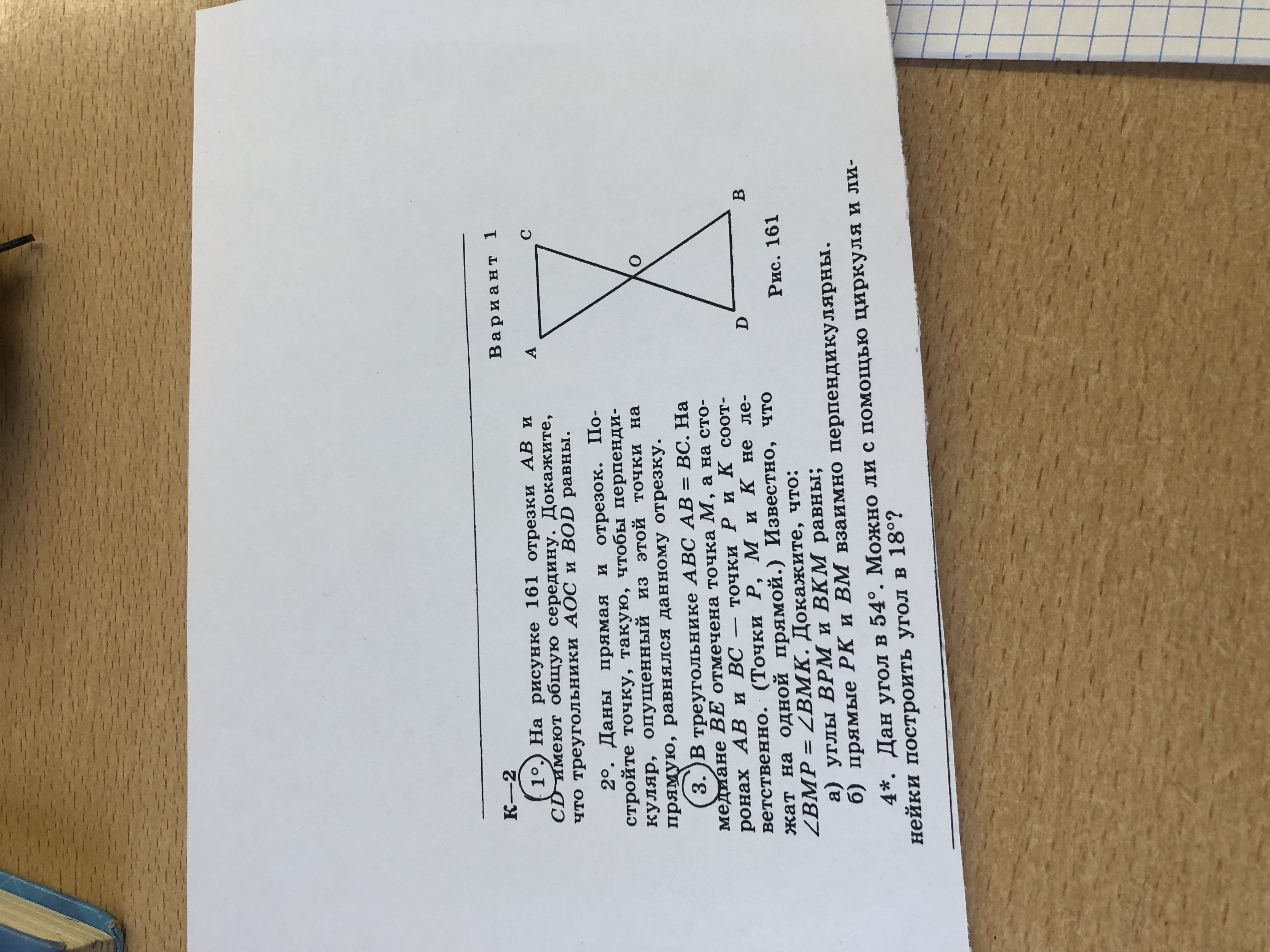
Let's go through the questions in the image, which is a geometry problem involving triangles and angles:
Assertion: The triangles ( \triangle AOS ) and ( \triangle BOD ) are equal.
Proof: If two triangles are claimed to be congruent, we typically need to prove one of the following sets of conditions:
- SSS (side-side-side),
- SAS (side-angle-side),
- ASA (angle-side-angle),
- AAS (angle-angle-side),
- RHS (right angle-hypotenuse-side for right triangles).
Without further information from the text or diagram interpretation, it’s often necessary to identify and use given congruencies, shared elements, parallelicity, or perpendicularity within the geometry of the figure.
Assertion: The triangles ( \triangle ACB ) and ( \triangle ADB ) are equal.
If segments ( AC = AD ) and segments ( BC = BD ), and angles opposite these segments or through shared points are equal, then explore angle-side-angle or other congruence tests.
Proof of ( \angle VBM = \angle VKM = 90^\circ ) if lines ( RK ) and ( NK ) are perpendicular.
This will depend on whether ( \angle VBM ) and ( \angle VKM ) are attached or have any shared perpendicular bisectors due to derivatives or bisector logic.
Constructing ( 54^\circ ) using a compass and straightedge:
To construct a ( 54^\circ ) angle:
- Construct a regular pentagon where each internal angle measures ( 108^\circ ).
- Since you want half of this angle, you may use bisection.
- Advanced constructions specific advice may apply depending on prior constructions made.
You can attempt to resolve these by finding additional diagrams or constructing step-by-step with basic Euclidean principles if you're attempting constructions or derivations yourself.
Понравился ответ?
Задай свой вопрос
Напиши любую задачу или вопрос, а нейросеть её решит


