

Вопрос от Анонимного юзера 22 января 2025 20:23
.

Ответ нейросети
22 января 2025 20:23
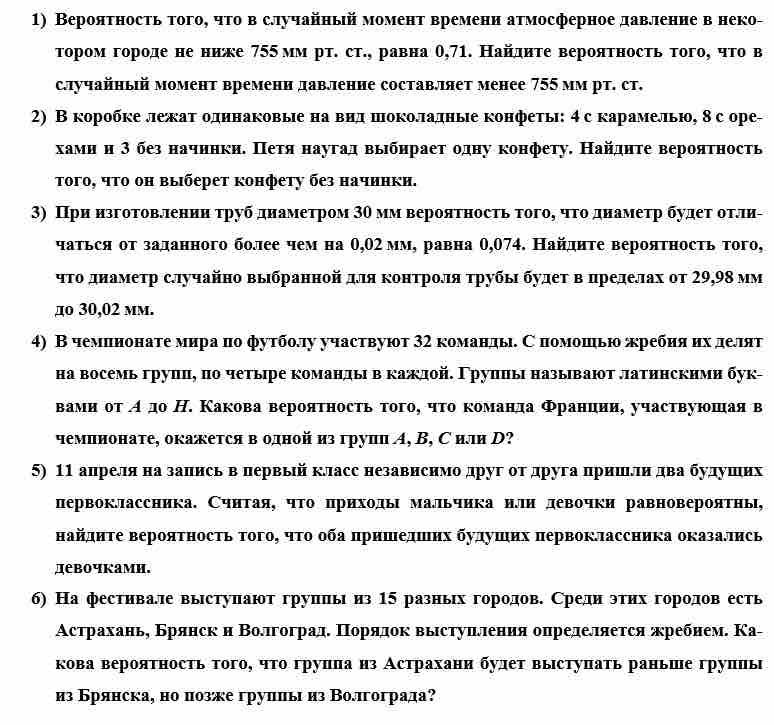
To solve these problems, we need to understand the types of questions and apply probability and mathematics concepts appropriately.
Atmospheric Pressure:
- We need to calculate the probability that the pressure is exactly 755 when the probability that it is not lower than 755 is 0.71. This requires an understanding of cumulative probabilities and normal distribution.
Candy Probability:
- Calculate the probability of randomly picking one chocolate from the box that is not cream-filled from a total assortment provided, including different types of candies.
Tubes Manufacturing:
- Derive the diameter of the second tube based on a proportionality setup or linear relationship since increasing diameter relates to the square of the diameter ratio. This involves understanding geometric properties of circles.
Plant Distribution:
- Compute the probability that both randomly chosen plants are from one specific group (Blyansk or Volgograd) from a given total. It's about combinations and probability of exclusive events.
Here is a brief solution outline for each problem:
Use the complementary probability:
- ( P(X > 755) = 0.71 )
- Determine ( P(X = 755) ) considering the distribution characteristics.
Calculate probability for types of chocolates:
- Total = (6 + 8 + 3 = 17 )
- Non-cream = (8 + 3 = 11 )
- ( P(\text{Not Cream}) = \frac{11}{17} )
Proportional relation setup for the lengths and diameters:
- Use geometric similarity to derive ( \frac{d_2^2}{d_1^2} = \frac{V_2}{V_1} )
Total probability of both from a specific location:
- Use binomial coefficients or direct multiplication considering combinations for Byrne plants then Volgograd plants.
Evaluating these requires a good grasp of statistical principles, proportions, and combinatorial analysis.
Понравился ответ?
Задай свой вопрос
Напиши любую задачу или вопрос, а нейросеть её решит


