Бесплатный урок с нашим репетитором!

Узнать подробнее

Новая Школа - онлайн-школа подготовки к ЕГЭ
При поддержке
Посмотреть все вопросы нейросети
Бесплатный пробный урок с репетитором

Узнай больше про репетиторов Новой Школы и запишись на бесплатный пробный урок. Мы проверим твой уровень знаний и составим план обучения по любому предмету и классу

Вопрос от Анонимного юзера 24 января 2025 11:33

7
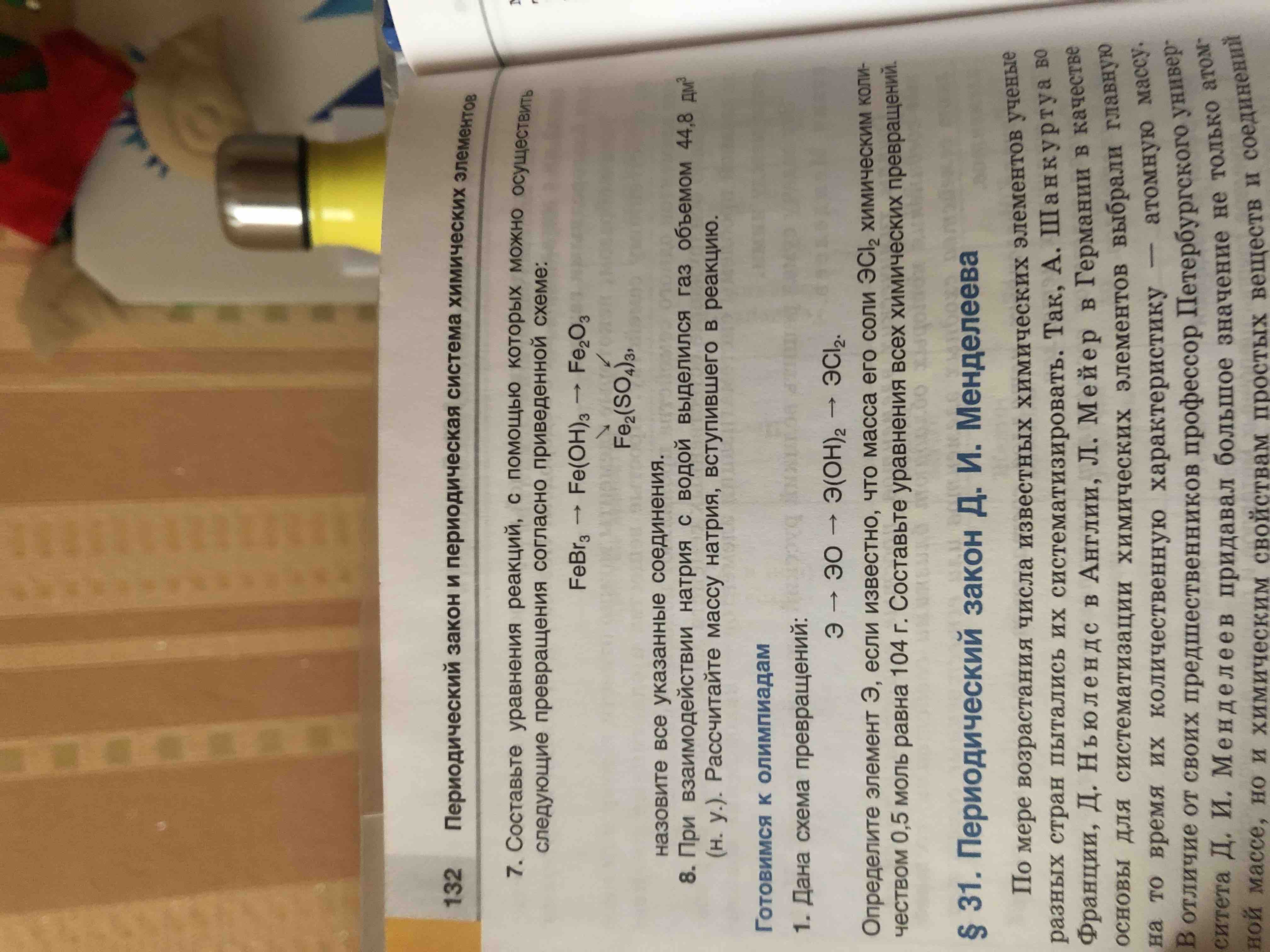
Ответ нейросети

24 января 2025 11:33

To solve this problem, we'll write the chemical equations for the described transformations:

  1. Iron to Ferric Chloride:

    [ 2 \text{Fe} + 3 \text{Cl}_2 \rightarrow 2 \text{FeCl}_3 ]

  2. Ferric Chloride to Ferric Hydroxide:

    [ \text{FeCl}_3 + 3 \text{NaOH} \rightarrow \text{Fe(OH)}_3 + 3 \text{NaCl} ]

  3. Ferric Hydroxide to Ferric Oxide:

    [ 2 \text{Fe(OH)}_3 \rightarrow \text{Fe}_2\text{O}_3 + 3 \text{H}_2\text{O} ]

  4. Ferric Oxide to Iron(III) Sulfate:

    [ \text{Fe}_2\text{O}_3 + 3 \text{H}_2\text{SO}_4 \rightarrow \text{Fe}_2(\text{SO}_4)_3 + 3 \text{H}_2\text{O} ]

Additionally, you are asked to find the mass of hydrogen that is released when 44.8 liters of hydrogen is produced in one of the reactions. The molar volume of an ideal gas is 22.4 L/mol at standard conditions, so the amount of hydrogen is:

  • Volume of H₂ given: 44.8 L.
  • Molar volume at STP: 22.4 L/mol.
  • Moles of H₂ = 44.8 L / 22.4 L/mol = 2 mol.

The mass of hydrogen ((H_2)) is:

  • Molar mass of H₂ = 2 g/mol.
  • Mass of 2 moles of H₂ = 2 mol × 2 g/mol = 4 g.

Therefore, the mass of the released hydrogen is 4 grams.

Задай свой вопрос

Напиши любую задачу или вопрос, а нейросеть её решит

Похожие вопросы 15

Бесплатно Мобильное приложение ГДЗ
Мобильное приложение ГДЗ

Задавай вопросы искуcственному интеллекту текстом или фотографиями в приложении на iPhone или Android

qr-codegoogle-playapp-store

Саша — ассистент в телеграмме

7
To solve this problem, we'll write the chemical equations for the described transformations: 1. **Iron to Ferric Chloride:** \[ 2 \text{Fe} + 3 \text{Cl}_2 \rightarrow 2 \text{FeCl}_3 \] 2. **Ferric Chloride to Ferric Hydroxide:** \[ \text{FeCl}_3 + 3 \text{NaOH} \rightarrow \text{Fe(OH)}_3 + 3 \text{NaCl} \] 3. **Ferric Hydroxide to Ferric Oxide:** \[ 2 \text{Fe(OH)}_3 \rightarrow \text{Fe}_2\text{O}_3 + 3 \text{H}_2\text{O} \] 4. **Ferric Oxide to Iron(III) Sulfate:** \[ \text{Fe}_2\text{O}_3 + 3 \text{H}_2\text{SO}_4 \rightarrow \text{Fe}_2(\text{SO}_4)_3 + 3 \text{H}_2\text{O} \] Additionally, you are asked to find the mass of hydrogen that is released when 44.8 liters of hydrogen is produced in one of the reactions. The molar volume of an ideal gas is 22.4 L/mol at standard conditions, so the amount of hydrogen is: - Volume of H₂ given: 44.8 L. - Molar volume at STP: 22.4 L/mol. - Moles of H₂ = 44.8 L / 22.4 L/mol = 2 mol. The mass of hydrogen (\(H_2\)) is: - Molar mass of H₂ = 2 g/mol. - Mass of 2 moles of H₂ = 2 mol × 2 g/mol = 4 g. Therefore, the mass of the released hydrogen is 4 grams.