Бесплатный урок с нашим репетитором!

Узнать подробнее

Новая Школа - онлайн-школа подготовки к ЕГЭ
При поддержке
Посмотреть все вопросы нейросети
Бесплатный пробный урок с репетитором

Узнай больше про репетиторов Новой Школы и запишись на бесплатный пробный урок. Мы проверим твой уровень знаний и составим план обучения по любому предмету и классу

Вопрос от Анонимного юзера 13 февраля 2025 05:39

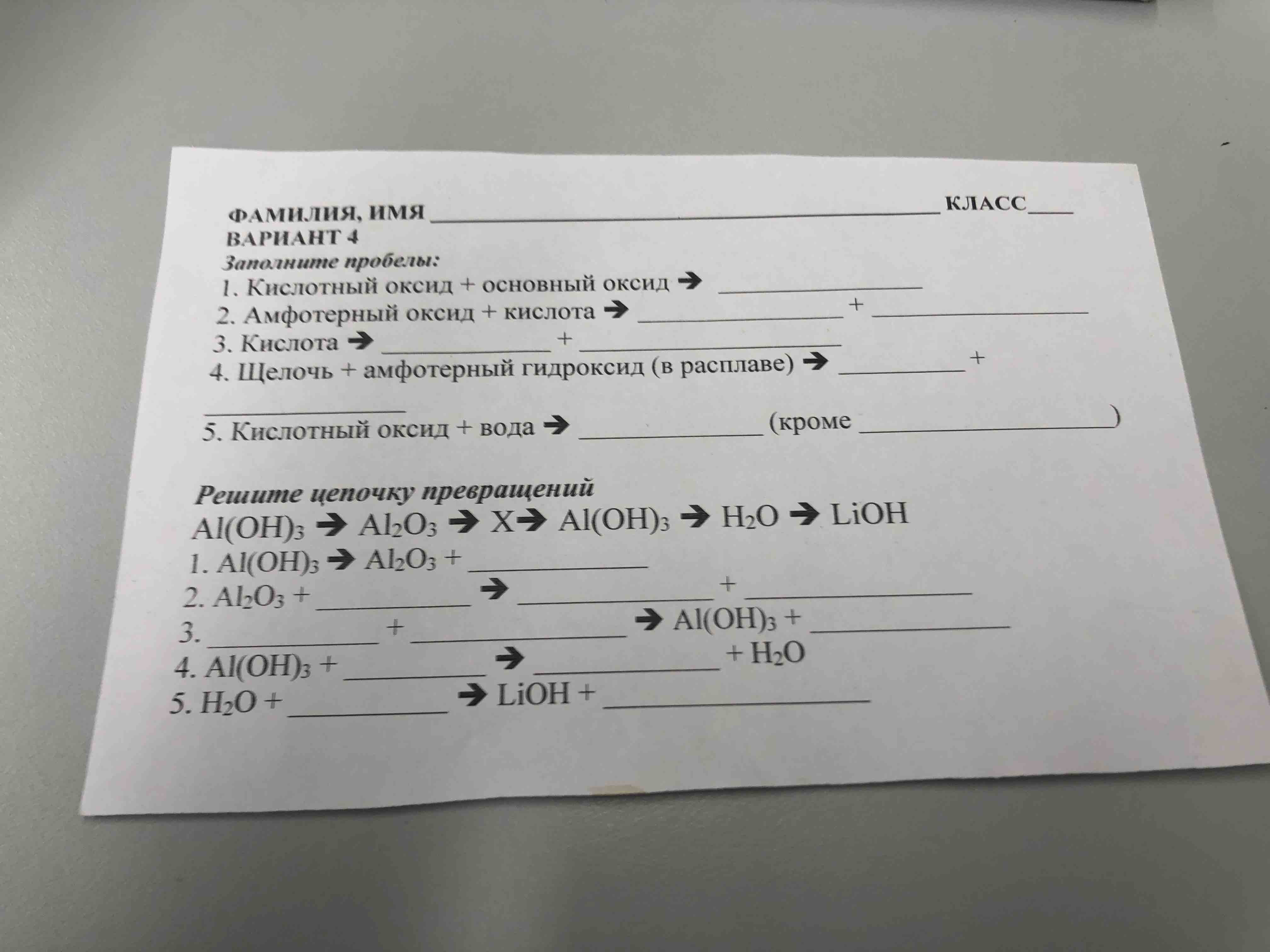
Реши цепочку

Ответ нейросети

13 февраля 2025 05:39

To solve the chain of transformations, we're dealing with the chemical properties of aluminum compounds and some general chemistry reactions.

Chain of Transformations

  1. ( \text{Al(OH)}_3 \xrightarrow{t} \text{Al}_2\text{O}_3 + \text{H}_2\text{O} )

    • Explanation: When aluminum hydroxide ( \text{Al(OH)}_3 ) is heated, it decomposes to form aluminum oxide ( \text{Al}_2\text{O}_3 ) and water. This is a typical dehydration reaction of hydroxides.
  2. ( \text{Al}_2\text{O}_3 + 2 \text{NaOH} \xrightarrow{\text{fusion}} 2 \text{NaAlO}_2 + \text{H}_2\text{O} )

    • Explanation: Aluminum oxide reacts with sodium hydroxide when melted together to form sodium aluminate ( \text{NaAlO}_2 ) and water. This is an example of aluminum oxide acting as an acid (acidic oxide) in a reaction with a base.
  3. ( \text{NaAlO}_2 + 4 \text{HCl} \rightarrow \text{AlCl}_3 + \text{NaCl} + 2 \text{H}_2\text{O} )

    • Explanation: Sodium aluminate reacts with hydrochloric acid to form aluminum chloride ( \text{AlCl}_3 ), sodium chloride ( \text{NaCl} ), and water. Here, the aluminate ion is neutralized by the acid.
  4. ( \text{AlCl}_3 + 3 \text{LiOH} \rightarrow \text{Al(OH)}_3 + 3 \text{LiCl} )

    • Explanation: Aluminum chloride reacts with lithium hydroxide, leading to the formation of aluminum hydroxide and lithium chloride. This is a double displacement reaction where the (\text{Cl}^-) and (\text{OH}^-) ions trade partners.

Summary of Process

  1. Dehydration: (\text{Al(OH)}_3) is heated to form (\text{Al}_2\text{O}_3).
  2. Fusion with Base: (\text{Al}_2\text{O}_3) reacts with (\text{NaOH}) to produce (\text{NaAlO}_2).
  3. Acid Neutralization: (\text{NaAlO}_2) is treated with (\text{HCl}) to yield (\text{AlCl}_3).
  4. Regeneration of Hydroxide: (\text{AlCl}_3) reacts with (\text{LiOH}) to form (\text{Al(OH)}_3).

This series of reactions demonstrates the characteristics of aluminum compounds as both an acid and a base (amphoteric behavior), as well as the typical interaction of metal hydroxides, oxides, and halides with acids and bases.

Задай свой вопрос

Напиши любую задачу или вопрос, а нейросеть её решит

Похожие вопросы 15

Бесплатно Мобильное приложение ГДЗ
Мобильное приложение ГДЗ

Задавай вопросы искуcственному интеллекту текстом или фотографиями в приложении на iPhone или Android

qr-codegoogle-playapp-store

Саша — ассистент в телеграмме

Реши цепочку
To solve the chain of transformations, we're dealing with the chemical properties of aluminum compounds and some general chemistry reactions. ### Chain of Transformations 1. **\( \text{Al(OH)}_3 \xrightarrow{t} \text{Al}_2\text{O}_3 + \text{H}_2\text{O} \)** - **Explanation:** When aluminum hydroxide \( \text{Al(OH)}_3 \) is heated, it decomposes to form aluminum oxide \( \text{Al}_2\text{O}_3 \) and water. This is a typical dehydration reaction of hydroxides. 2. **\( \text{Al}_2\text{O}_3 + 2 \text{NaOH} \xrightarrow{\text{fusion}} 2 \text{NaAlO}_2 + \text{H}_2\text{O} \)** - **Explanation:** Aluminum oxide reacts with sodium hydroxide when melted together to form sodium aluminate \( \text{NaAlO}_2 \) and water. This is an example of aluminum oxide acting as an acid (acidic oxide) in a reaction with a base. 3. **\( \text{NaAlO}_2 + 4 \text{HCl} \rightarrow \text{AlCl}_3 + \text{NaCl} + 2 \text{H}_2\text{O} \)** - **Explanation:** Sodium aluminate reacts with hydrochloric acid to form aluminum chloride \( \text{AlCl}_3 \), sodium chloride \( \text{NaCl} \), and water. Here, the aluminate ion is neutralized by the acid. 4. **\( \text{AlCl}_3 + 3 \text{LiOH} \rightarrow \text{Al(OH)}_3 + 3 \text{LiCl} \)** - **Explanation:** Aluminum chloride reacts with lithium hydroxide, leading to the formation of aluminum hydroxide and lithium chloride. This is a double displacement reaction where the \(\text{Cl}^-\) and \(\text{OH}^-\) ions trade partners. ### Summary of Process 1. **Dehydration:** \(\text{Al(OH)}_3\) is heated to form \(\text{Al}_2\text{O}_3\). 2. **Fusion with Base:** \(\text{Al}_2\text{O}_3\) reacts with \(\text{NaOH}\) to produce \(\text{NaAlO}_2\). 3. **Acid Neutralization:** \(\text{NaAlO}_2\) is treated with \(\text{HCl}\) to yield \(\text{AlCl}_3\). 4. **Regeneration of Hydroxide:** \(\text{AlCl}_3\) reacts with \(\text{LiOH}\) to form \(\text{Al(OH)}_3\). This series of reactions demonstrates the characteristics of aluminum compounds as both an acid and a base (amphoteric behavior), as well as the typical interaction of metal hydroxides, oxides, and halides with acids and bases.