Бесплатный урок с нашим репетитором!

Узнать подробнее

Новая Школа - онлайн-школа подготовки к ЕГЭ
При поддержке
Посмотреть все вопросы нейросети
Бесплатный пробный урок с репетитором

Узнай больше про репетиторов Новой Школы и запишись на бесплатный пробный урок. Мы проверим твой уровень знаний и составим план обучения по любому предмету и классу

Вопрос от Анастасия ㅤ 08 января 2025 13:33

?

Ответ нейросети

08 января 2025 13:33

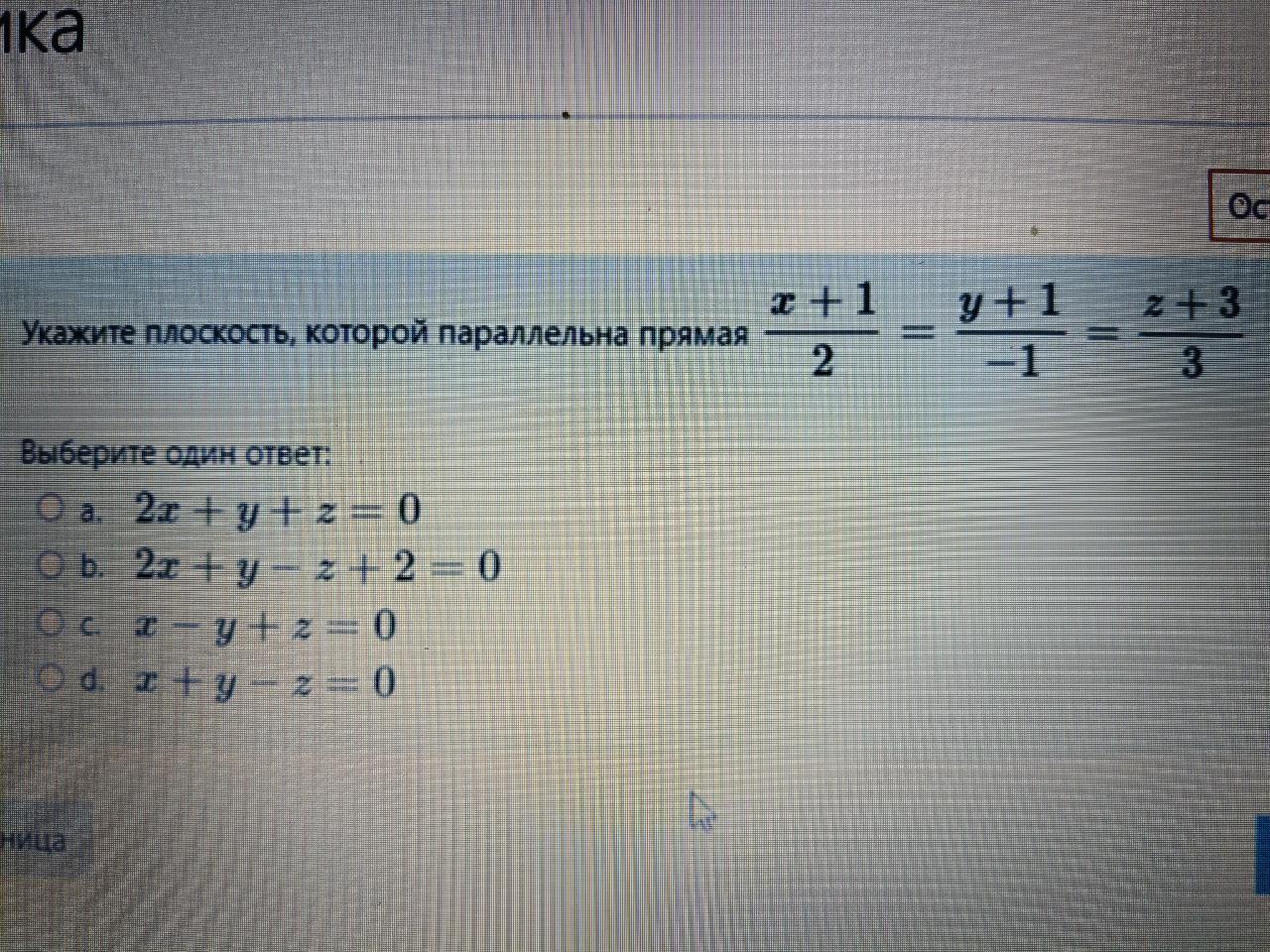
To determine which plane is parallel to the given line, we need to find the direction vector of the line and then find a plane whose normal vector is orthogonal to the line's direction vector.

From the line equation:

[ \frac{x+1}{2} = \frac{y+1}{-1} = \frac{z+3}{3} ]

The direction vector of the line is ( (2, -1, 3) ).

Let's find the normal vectors of the planes given in the options and see which one is orthogonal to the direction vector:

a. (2x + y + z = 0)
Normal vector: ((2, 1, 1))

b. (2x + y - 2z = 0)
Normal vector: ((2, 1, -2))

c. (x + y + z = 0)
Normal vector: ((1, 1, 1))

d. (x + y - z = 0)
Normal vector: ((1, 1, -1))

To check for orthogonality, we find the dot product of the line’s direction vector with each plane's normal vector. The dot product should be zero for orthogonal vectors.

  • For option a: (2 \cdot 2 + (-1) \cdot 1 + 3 \cdot 1 = 4 - 1 + 3 = 6)
  • For option b: (2 \cdot 2 + (-1) \cdot 1 + 3 \cdot (-2) = 4 - 1 - 6 = -3)
  • For option c: (2 \cdot 1 + (-1) \cdot 1 + 3 \cdot 1 = 2 - 1 + 3 = 4)
  • For option d: (2 \cdot 1 + (-1) \cdot 1 + 3 \cdot (-1) = 2 - 1 - 3 = -2)

None of the planes have a normal vector that is orthogonal to the direction vector (as none of the dot products are zero), indicating an error in the options provided, or there might have been a mistake in the transcription. Please check the options again or provide additional context.

Задай свой вопрос

Напиши любую задачу или вопрос, а нейросеть её решит

Похожие вопросы 15

Бесплатно Мобильное приложение ГДЗ
Мобильное приложение ГДЗ

Задавай вопросы искуcственному интеллекту текстом или фотографиями в приложении на iPhone или Android

qr-codegoogle-playapp-store

Саша — ассистент в телеграмме

?
To determine which plane is parallel to the given line, we need to find the direction vector of the line and then find a plane whose normal vector is orthogonal to the line's direction vector. From the line equation: \[ \frac{x+1}{2} = \frac{y+1}{-1} = \frac{z+3}{3} \] The direction vector of the line is \( (2, -1, 3) \). Let's find the normal vectors of the planes given in the options and see which one is orthogonal to the direction vector: a. \(2x + y + z = 0\) Normal vector: \((2, 1, 1)\) b. \(2x + y - 2z = 0\) Normal vector: \((2, 1, -2)\) c. \(x + y + z = 0\) Normal vector: \((1, 1, 1)\) d. \(x + y - z = 0\) Normal vector: \((1, 1, -1)\) To check for orthogonality, we find the dot product of the line’s direction vector with each plane's normal vector. The dot product should be zero for orthogonal vectors. - For option a: \(2 \cdot 2 + (-1) \cdot 1 + 3 \cdot 1 = 4 - 1 + 3 = 6\) - For option b: \(2 \cdot 2 + (-1) \cdot 1 + 3 \cdot (-2) = 4 - 1 - 6 = -3\) - For option c: \(2 \cdot 1 + (-1) \cdot 1 + 3 \cdot 1 = 2 - 1 + 3 = 4\) - For option d: \(2 \cdot 1 + (-1) \cdot 1 + 3 \cdot (-1) = 2 - 1 - 3 = -2\) None of the planes have a normal vector that is orthogonal to the direction vector (as none of the dot products are zero), indicating an error in the options provided, or there might have been a mistake in the transcription. Please check the options again or provide additional context.