Бесплатный урок с нашим репетитором!

Узнать подробнее

Новая Школа - онлайн-школа подготовки к ЕГЭ
При поддержке
Посмотреть все вопросы нейросети
Бесплатный пробный урок с репетитором

Узнай больше про репетиторов Новой Школы и запишись на бесплатный пробный урок. Мы проверим твой уровень знаний и составим план обучения по любому предмету и классу

Вопрос от Анонимного юзера 22 января 2025 21:33

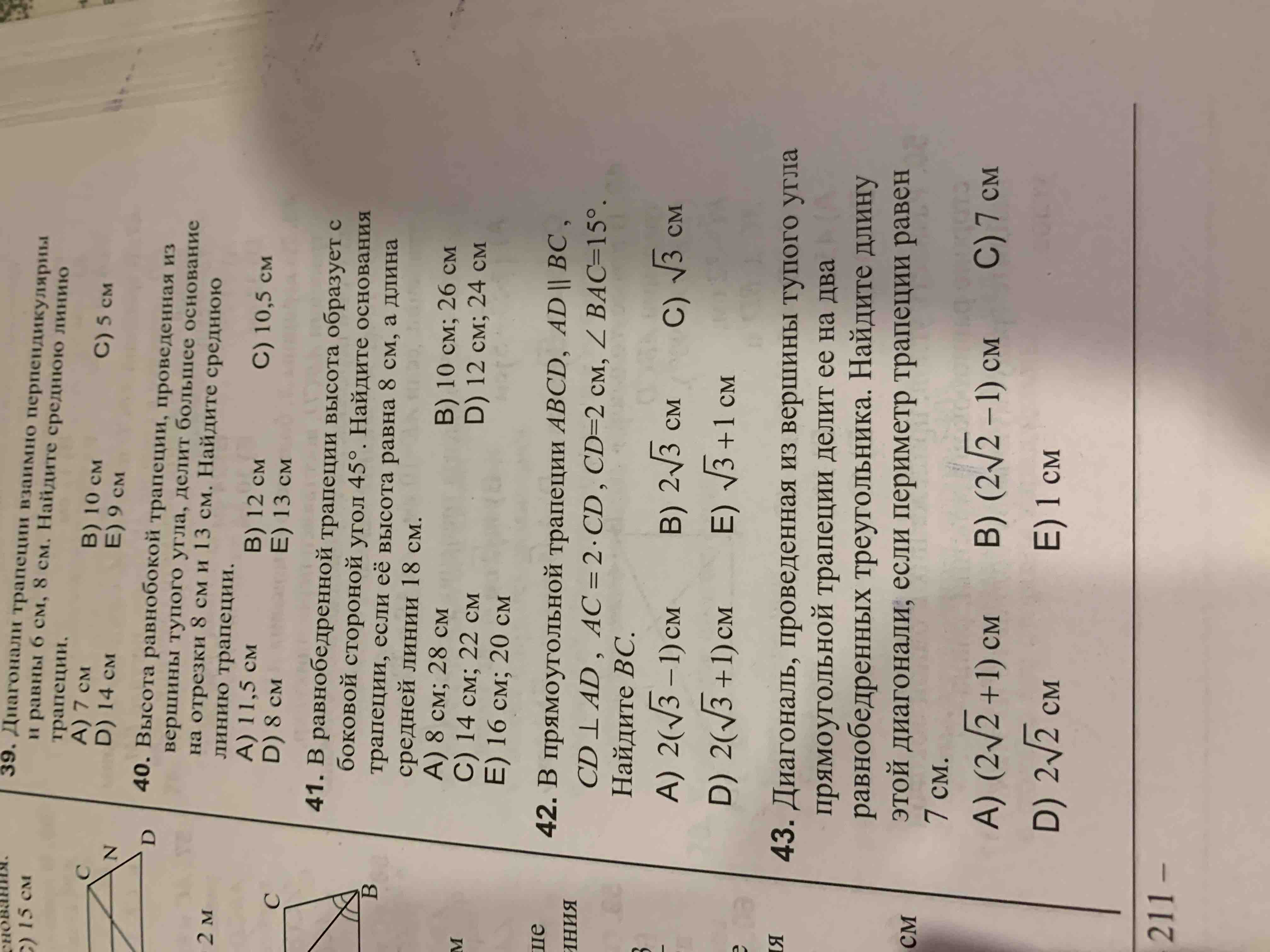
42
Ответ нейросети

22 января 2025 21:33

To solve problem 42, you need to find ( x ) in trapezoid ( ABCD ) with the given conditions:

  • ( AD = 10 ) cm
  • ( BC = 12 ) cm
  • ( CD = 8 ) cm
  • ( \angle BAC = 15^\circ )

The law of cosines or properties of triangles and trapezoids approach can be used. However, since the exact value of (\angle BAC) and dimensions form a unique geometric situation, a diagram or additional geometric relationships might be needed for a complete solution.

For an accurate solution, evaluating specific trigonometric or geometric methods based on the constraints given would be necessary. Would you like more details on trapezoid properties or methods typically used in such problems?

Задай свой вопрос

Напиши любую задачу или вопрос, а нейросеть её решит

Похожие вопросы 15

Бесплатно Мобильное приложение ГДЗ
Мобильное приложение ГДЗ

Задавай вопросы искуcственному интеллекту текстом или фотографиями в приложении на iPhone или Android

qr-codegoogle-playapp-store

Саша — ассистент в телеграмме

42
To solve problem 42, you need to find \( x \) in trapezoid \( ABCD \) with the given conditions: - \( AD = 10 \) cm - \( BC = 12 \) cm - \( CD = 8 \) cm - \( \angle BAC = 15^\circ \) The law of cosines or properties of triangles and trapezoids approach can be used. However, since the exact value of \(\angle BAC\) and dimensions form a unique geometric situation, a diagram or additional geometric relationships might be needed for a complete solution. For an accurate solution, evaluating specific trigonometric or geometric methods based on the constraints given would be necessary. Would you like more details on trapezoid properties or methods typically used in such problems?