Бесплатный урок с нашим репетитором!

Узнать подробнее

Новая Школа - онлайн-школа подготовки к ЕГЭ
При поддержке
Посмотреть все вопросы нейросети
Бесплатный пробный урок с репетитором

Узнай больше про репетиторов Новой Школы и запишись на бесплатный пробный урок. Мы проверим твой уровень знаний и составим план обучения по любому предмету и классу

Вопрос от Анонимного юзера 29 января 2025 03:24

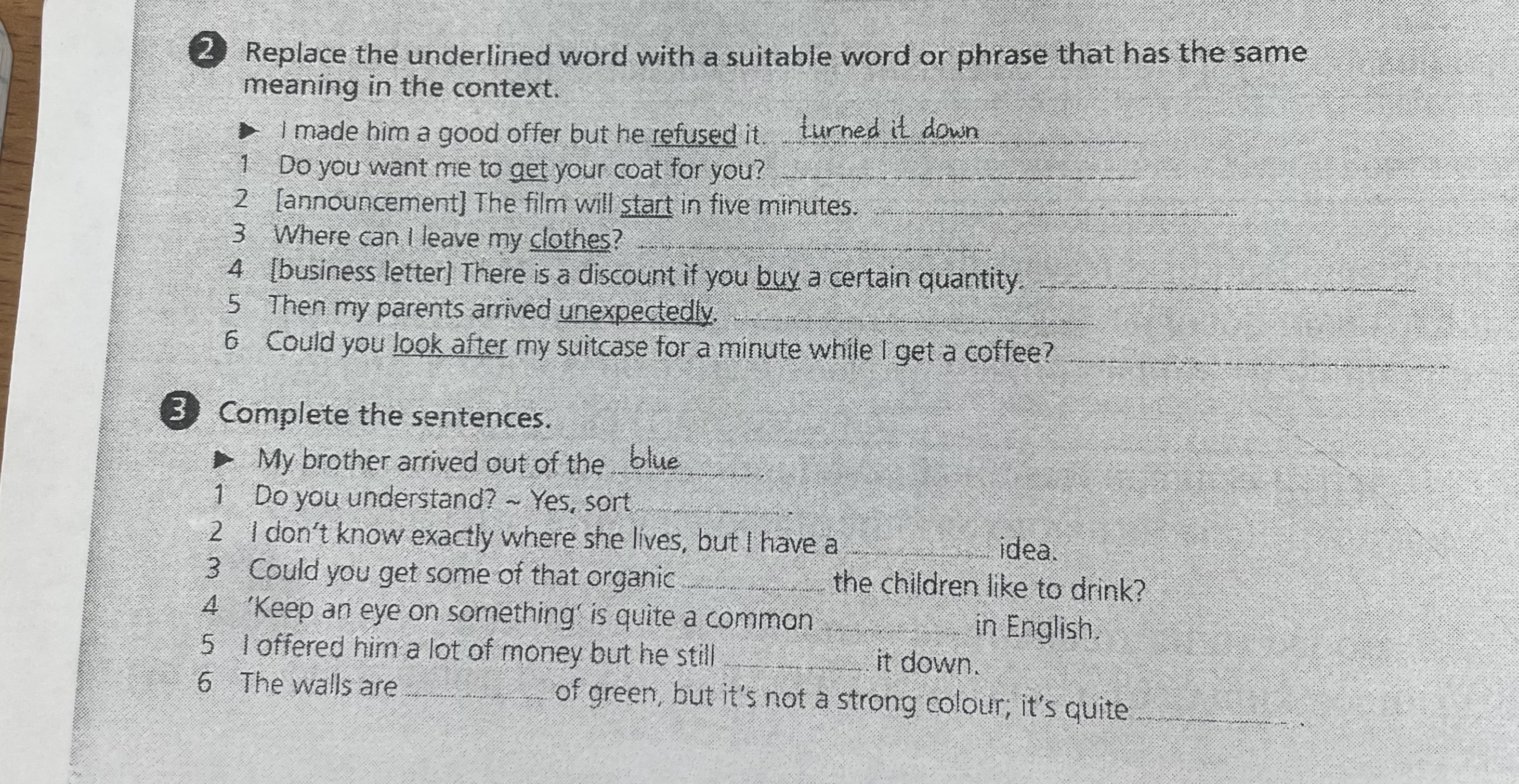
Replace

Ответ нейросети

29 января 2025 03:24

To solve the problem, we'll replace the underlined words with suitable ones that have the same meaning in the context.

  1. "refused it" - The word "refused" means to decline or not accept.

    • Original: I made him a good offer but he refused it.
    • Replacement: I made him a good offer but he turned it down.
  2. "to get" - Means to obtain or fetch.

    • Original: Could you go to get your coat for you?
    • Replacement: Could you go and fetch your coat for you?
  3. "will start" - To begin or commence.

    • Original: [announcement] The film will start in five minutes.
    • Replacement: [announcement] The film will begin in five minutes.
  4. "leave my clothes" - To place or put them somewhere.

    • Original: Where can I leave my clothes?
    • Replacement: Where can I put my clothes?
  5. "if you buy" - To make a purchase; acquisition upon buying.

    • Original: There is a discount if you buy a certain quantity.
    • Replacement: There is a discount when you purchase a certain quantity.
  6. "unexpectedly" - Means without warning or suddenly.

    • Original: His parents arrived unexpectedly.
    • Replacement: His parents arrived suddenly.
  7. "look after" - Means to take care of or oversee.

    • Original: Could you look after my suitcase for a minute while I get a coffee?
    • Replacement: Could you watch my suitcase for a minute while I get a coffee?

Complete the sentences based on context:

  1. "out of the blue" - Means unexpectedly or without warning.

    • Original: My brother arrived out of the blue.
  2. "Yes, sir, but I have no idea" - "Yes" indicates affirmation, "but" introduces a contrast or lack of understanding.

    • Original: Do you understand? - Yes sir, but I have no idea.
  3. "Do you get some of that organic" - Asking if someone buys or consumes organic produce.

    • Original: Could you get some of that organic produce?
  4. "quite common" - Means very frequent or usual.

    • Original: To keep an eye on something is quite common in English.
  5. "a fortune" - A large amount of money.

    • Original: I offered him a lot of money, but he still demanded a fortune.
  6. "of green" - Describing a characteristic color; it's not strong.

    • Original: The walls are of green, but it’s not a strong colour, it’s quite pale.

Задай свой вопрос

Напиши любую задачу или вопрос, а нейросеть её решит

Похожие вопросы 15

Бесплатно Мобильное приложение ГДЗ
Мобильное приложение ГДЗ

Задавай вопросы искуcственному интеллекту текстом или фотографиями в приложении на iPhone или Android

qr-codegoogle-playapp-store

Саша — ассистент в телеграмме

Replace
To solve the problem, we'll replace the underlined words with suitable ones that have the same meaning in the context. 1. "**refused it**" - The word "refused" means to decline or not accept. - Original: I made him a good offer but he **refused it**. - Replacement: I made him a good offer but he **turned it down**. 2. "**to get**" - Means to obtain or fetch. - Original: Could you go **to get** your coat for you? - Replacement: Could you go **and fetch** your coat for you? 3. "**will start**" - To begin or commence. - Original: [announcement] The film **will start** in five minutes. - Replacement: [announcement] The film **will begin** in five minutes. 4. "**leave my clothes**" - To place or put them somewhere. - Original: Where can I **leave my clothes**? - Replacement: Where can I **put my clothes**? 5. "**if you buy**" - To make a purchase; acquisition upon buying. - Original: There is a discount **if you buy** a certain quantity. - Replacement: There is a discount **when you purchase** a certain quantity. 6. "**unexpectedly**" - Means without warning or suddenly. - Original: His parents arrived **unexpectedly**. - Replacement: His parents arrived **suddenly**. 7. "**look after**" - Means to take care of or oversee. - Original: Could you **look after** my suitcase for a minute while I get a coffee? - Replacement: Could you **watch** my suitcase for a minute while I get a coffee? --- Complete the sentences based on context: 1. "**out of the blue**" - Means unexpectedly or without warning. - Original: My brother arrived **out of the blue**. 2. "**Yes, sir, but I have no idea**" - "Yes" indicates affirmation, "but" introduces a contrast or lack of understanding. - Original: Do you understand? - **Yes sir, but I have no idea**. 3. "**Do you get some of that organic**" - Asking if someone buys or consumes organic produce. - Original: Could you get some of that organic **produce?** 4. "**quite common**" - Means very frequent or usual. - Original: To keep an eye on something is **quite common** in English. 5. "**a fortune**" - A large amount of money. - Original: I offered him a lot of money, but he still demanded **a fortune**. 6. "**of green**" - Describing a characteristic color; it's not strong. - Original: The walls are **of green**, but it’s not a strong colour, it’s quite pale.