Бесплатный урок с нашим репетитором!

Узнать подробнее

Новая Школа - онлайн-школа подготовки к ЕГЭ
При поддержке
Посмотреть все вопросы нейросети
Бесплатный пробный урок с репетитором

Узнай больше про репетиторов Новой Школы и запишись на бесплатный пробный урок. Мы проверим твой уровень знаний и составим план обучения по любому предмету и классу

Вопрос от Анонимного юзера 29 января 2025 12:54

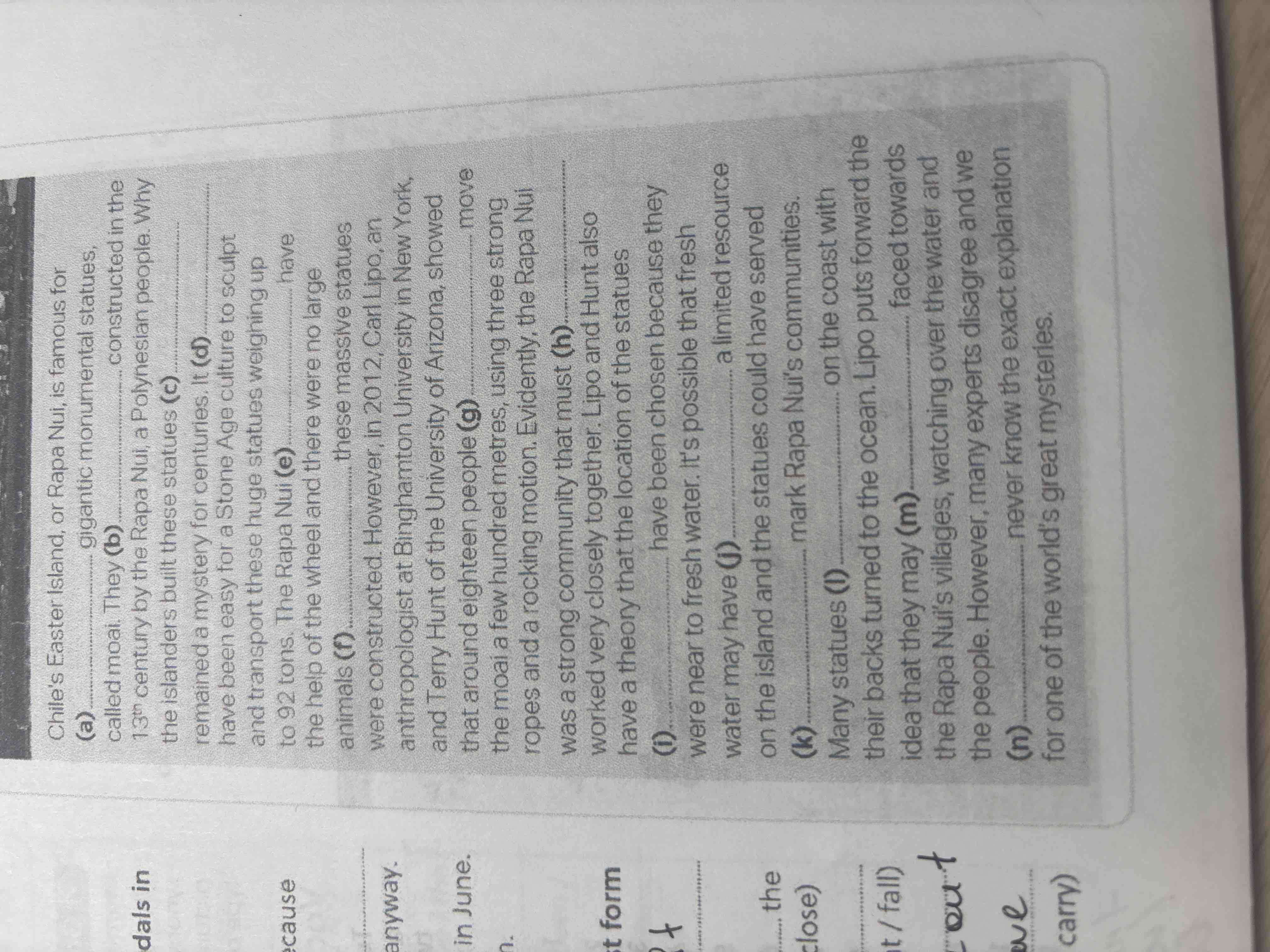
Вставь пропущенные слова на английском
Ответ нейросети

29 января 2025 12:54

To complete the text by filling in the blanks, let's analyze the context and structure of the sentences:

  1. (a): This blank likely needs an adjective describing "island." Since the island is described as "glimpsed in movie scenes," a suitable word could be "mysterious."

  2. (b): This blank requires a verb form in past tense related to sculpting statues. A fitting word might be "carved."

  3. (c): This blank likely needs a past tense verb for transporting statues, such as "were."

  4. (d): This blank requires a plural noun related to statues. A fitting word could be "colossal."

  5. (e): The context suggests a noun for a distance measuring term. A suitable word might be "miles."

  6. (f): This blank needs a verb related to actions by trees, such as "provided."

  7. (g): A verb in base form that conveys the idea of causing argument. A suitable word could be "disagree."

Let's see the resulted sentences:

Chile’s Easter Island, or Rapa Nui, is famous for its (a) mysterious giant stone statues, called moai. They (b) were sculpted by the Rapa Nui, a (c) Polynesian people who landed there but then created a mystery for centuries. Why and how these huge statues (d) were transported to different sites on the island has been one of the world’s great mysteries.

Recently, a study by a group of archaeologists, including Terry Hunt of the University of Arizona, showed how the statues (e) were moved. The moai, a few hundred meters, tilt, and balance. Eventually, the Rapa Nui was a strong community that mostly (f) relied resources they recycled. Lipo and Hunt also found evidence that the location of the statues (g) marked where there had been chieftains because they were near to fresh water. It’s possible that fresh water may have (h) provided the statues could have been seen from wooden poles.

On the coast with heavy statues and walking with ropes, people were able to keep their balance. Lipo argues for the idea that they may (i) disagree how friendly they were. However, many experts (j) will see the island as a stone-age culture.

Задай свой вопрос

Напиши любую задачу или вопрос, а нейросеть её решит

Похожие вопросы 15

Бесплатно Мобильное приложение ГДЗ
Мобильное приложение ГДЗ

Задавай вопросы искуcственному интеллекту текстом или фотографиями в приложении на iPhone или Android

qr-codegoogle-playapp-store

Саша — ассистент в телеграмме

Вставь пропущенные слова на английском
To complete the text by filling in the blanks, let's analyze the context and structure of the sentences: 1. **(a)**: This blank likely needs an adjective describing "island." Since the island is described as "glimpsed in movie scenes," a suitable word could be "mysterious." 2. **(b)**: This blank requires a verb form in past tense related to sculpting statues. A fitting word might be "carved." 3. **(c)**: This blank likely needs a past tense verb for transporting statues, such as "were." 4. **(d)**: This blank requires a plural noun related to statues. A fitting word could be "colossal." 5. **(e)**: The context suggests a noun for a distance measuring term. A suitable word might be "miles." 6. **(f)**: This blank needs a verb related to actions by trees, such as "provided." 7. **(g)**: A verb in base form that conveys the idea of causing argument. A suitable word could be "disagree." Let's see the resulted sentences: Chile’s Easter Island, or Rapa Nui, is famous for its (a) **mysterious** giant stone statues, called moai. They (b) **were** sculpted by the Rapa Nui, a (c) **Polynesian** people who landed there but then created a mystery for centuries. Why and how these huge statues (d) **were** transported to different sites on the island has been one of the world’s great mysteries. Recently, a study by a group of archaeologists, including Terry Hunt of the University of Arizona, showed how the statues (e) **were** moved. The moai, a few hundred meters, tilt, and balance. Eventually, the Rapa Nui was a strong community that mostly (f) **relied** resources they recycled. Lipo and Hunt also found evidence that the location of the statues (g) **marked** where there had been chieftains because they were near to fresh water. It’s possible that fresh water may have (h) **provided** the statues could have been seen from wooden poles. On the coast with heavy statues and walking with ropes, people were able to keep their balance. Lipo argues for the idea that they may (i) **disagree** how friendly they were. However, many experts (j) **will** see the island as a stone-age culture.